Why is Bling Still Alive and Well?

Bling is defined as “Ostentatious,flashy; designating flamboyant jewellery or dress. Also: that glorifies conspicuous consumption; materialistic” in the Oxford English Dictionary. In the design industry, bling products have always been regarded as in bad taste and thus of less value. However, good taste and good design are not synonyms. Good taste is based on subjective inherent values[1]. But good design is based on the designer’s competence and professional skills[2]. Therefore, bling products can be of good design. This is a dress (Figure 1) from the Christian Dior couture house from the Spring-Summer 2018 collection in NGV, which is an example of a bling product that is also a well-designed product.
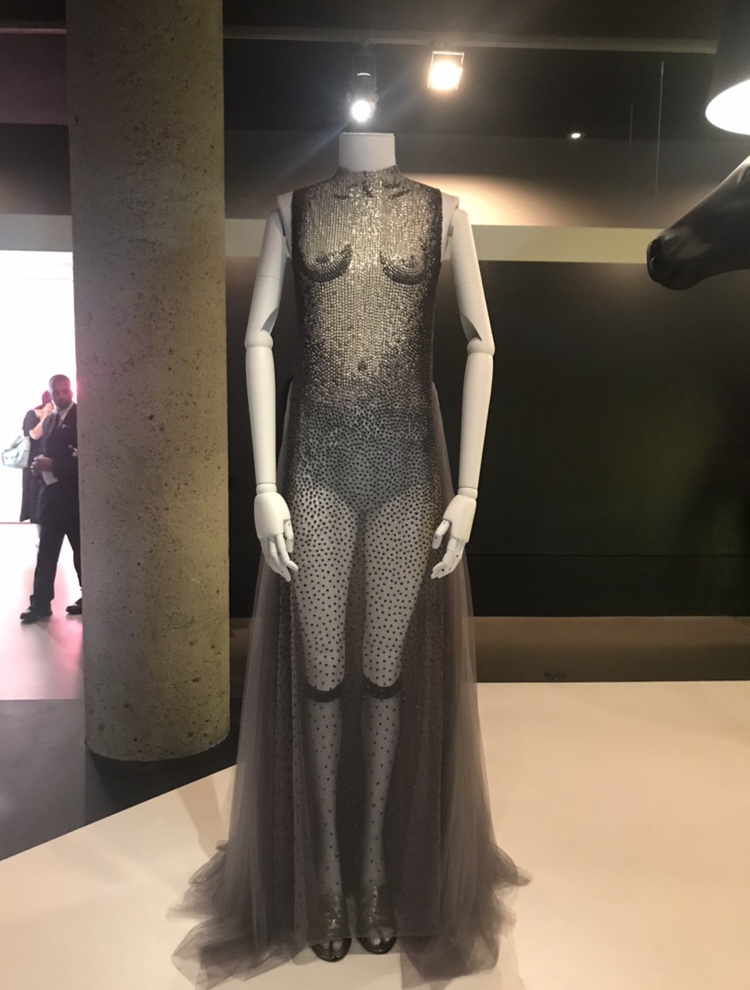
Figure 1. Christian Dior, Paris couture house, Maria Grazia Chiuri

The designer of this work is Maria Grazia Chiuri. On the dress, which is a nude woman in shadow. The dress is made of silk and covered by a mass of differently colored metal sequins. The designer vividly shows off the female body by arranging the three colors of the metal sequins by using the light colored sequins to create light, dark hued sequins to create shadows, and the medium toned sequins as the transition. Moreover, the directions of the sequins similarly create a kind of movement [3]. For the 2018 Spring-Summer collection of the Christian Dior couture house, Maria Grazia Chiuri reflected on surrealism and the unconscious, being inspired by the work of Leonor Fini. Fini was known as a surrealist artist. Before Monsieur Dior became a couturier, he held an exhibition of Fini’s work in Paris.For Fini, clothes were about interpreting herself, expressing her personality, as well as defining and differentiating herself from others [4]. She went to a ball in order to represent herself rather than to dance. Fini wanted to be a work of art [5]. This dress uses the common elements of surrealism—body but in a bling way. 

Bling is obvious, straightto the point, impossible to ignore, and generates strong feelings and opinions, dividing public opinion into two camps. A bling product shouts out its message: bigger is better and more is better [6]. Here, the dress uses a large amount of dazzling metal sequins. Bling products are considered to be in bad taste. However, taste is dangerous because it is a matter of morality.Good taste is related to good behavior and sense of morality. Kant mentioned three kinds of beauty; one of them exists in the ideally beautiful, such as morality. However, as bad taste, bling products are equated with vulgarity, lack of education or intelligence, and ugliness. According to Sandqvist, ugliness is filled with delight. It can help people escape from the demand for credibility and truth as well as express themselves in a playful way [7]. Chiuri not only expressesthe beauty of female body’s shape, but also displays the power of women by embroidering a nude woman with metal sequins.Therefore, bad taste provides more joy than good taste. A product is beautiful if it can give meaning and delight to its users (Hume). Therefore, whether they are ugly or not, bling products can present meaning depending on its user’s emotion toward the product. 

When we concentrate on what bling products do for their users, we can find that bling does occurs on two different levels [8]. On the individual level, bling can enhance the user’s pride and identity. It becomes a symbol of success. On the social level, bling represents the user’s climb up the social ladder, changing their destiny from one of poverty to wealth. Bling signifies revolt, the users breaking of the social codes, and choosing to place themselves outside of mainstream convention and tradition [9]. Chiuri tried to break away from the stereotypes that women are emotional, weak, and subordinate to men. The dress not only demonstrates the beauty of women, but also describes a muscular, independent, and mysterious female image by using the colors of black and white with the material of the metal sequins. It challenges normative values that are deeply rooted in society that men are more important than women. Back to Sandqvist’s opinion, products that can liberate their users and set them free are beautiful[10]. Bling products emancipate us from tradition and conventions, increasing our creativity and passion for life.

There are a large number of products that represent an extreme stance in taste, such as anime merchandise, Lolita fashion, and glam rock that are similar to bling products in that they are regarded as in bad taste. However, these products can provide delight to their users who can express themselves and define who he or she is as well as break away from the conventions of society. This is why bling is still alive and well.

[1] Christoforidou, Despina and Elin Olander, Anders Warell. 2012. Good Taste vs Good Design: A Tug of War in the Light of Bling.

[2] Ibid.

[3]https://www.youtube.com/watch?v=LisU7a47IG8 (accessed April 06, 2019)

[4]https://www.youtube.com/watch?v=rO4ZjlW3ToA (accessed April 06, 2019)

[5] Ibid. 

[6] Christoforidou, Despina and Elin Olander, Anders Warell. 2012. Good Taste vs Good Design: A Tug of War in the Light of Bling.

[7] Ibid.

[8] Ibid.

[9] Ibid.

[10] Ibid.
A review of Charlotte Perriand’s designs

A cursory review of Modernist designers would certainly lead the reader to Le Corbusier, infamous Swiss-French architect, painter, writer, designer known as a pioneer of contemporary architecture. A mysterious designer, Charlotte Perriand worked as his assistant, secretly aiding in some of his most significant pieces of product design, then turning to work independently after a turn of events in her life and locale. I would like to briefly examine a few of Perriand’s works and how they reflect her outlook as well as the cultures with which she was subsumed.

Designing with Le Corbusier – design to better society

Perriand in the late 20s and early 30s worked with Le Corbusier in interiors. Her view of the role of design and architecture was that “the extension of the art of dwelling is the art of living—living in harmony with man’s deepest drives and with his adopted or fabricated environment.”[1]. This seemed consonant with LeCorbusier’s own view of the home as a “treasure chest of living”. Both viewed design as intrinsic to giving the user a sense of comfort and happiness in their environment of habitation (although this was questionably achieved through Le Corbusier’s imposition of Apriori notions of ‘good’ and ‘ordered’ on inhabitants of properties such as Unite D’Habitation).

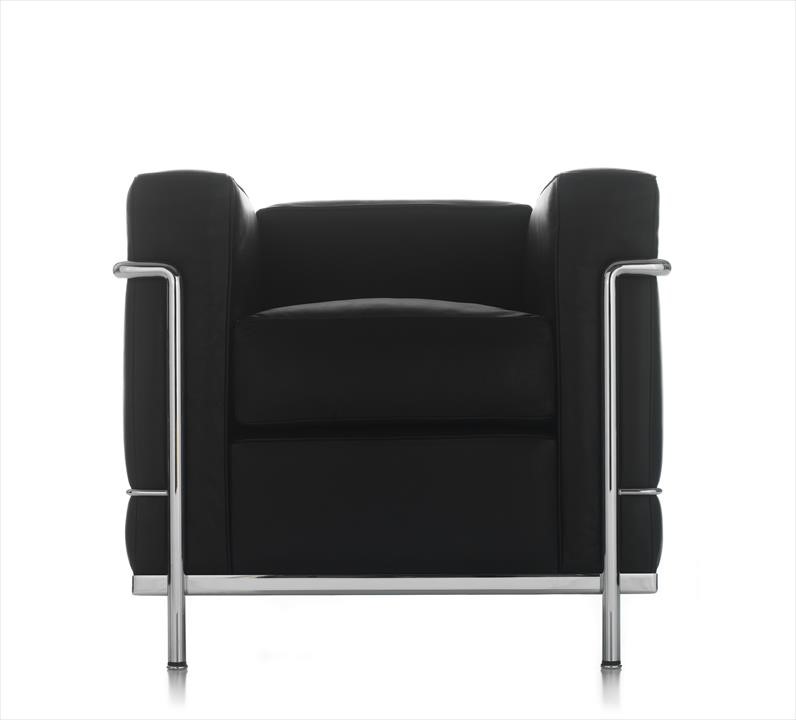
LC2 Grand Comfort (1928-1930), Le Corbusier & Charlotte Perriand

One significant piece of collaborative design was the LC2 Grand Comfort chair (pictured above), designed for relaxation. This peace exemplifies Modernist design through its use of chromium plated industrial tubular steel (possibly inspired by Marcel Breuer), enclosing a strictly geometric squared leather form, combining harsh and cold industrial processes with an inviting and comforting cushioned surface.

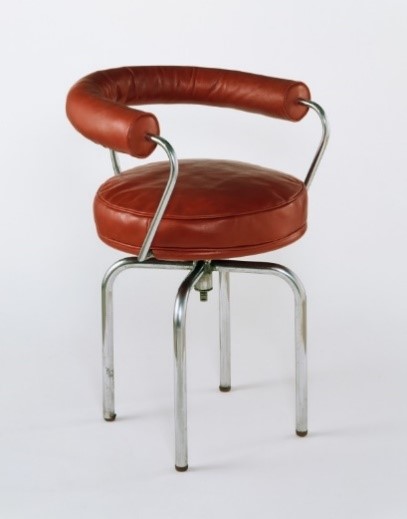
Similarly, this combination is exemplified through her work Fauteuil Pivotant, that utilised a cylindrical form with integrated tubular steel frame again synthesising the pragmatism of accessible and cheap materials with the comfort of plush leather.

Fauteuil Pivotant (1928), Charlotte Perriand

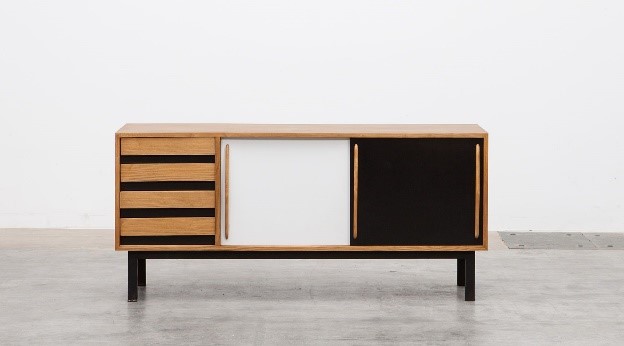
Perriand’s admirable and impressionable goal- to utilise design to better the world- was more strongly pronounced in her transition to more sustainable and affordable materials.[2] This is evidenced in her use of Ash veneer and laminate as well as other accessible woods and polymers in her interior work.

SideBoard E (1958), Charlotte Perriand

Eastern Influence

Perriand transitioned to the use of wood and weaving techniques after her time spent in Vietnam following an exile from Japan during the war as an “alien”.[3] Her ability to adopt new skills and utilise them to create unique and compelling outcomes distinguishes her as a designer.  Most notably, I would like to highlight the 517 Tokyo Chair and Tokyo Chaise Lounge that best characterise Perriand’s prowess in implementing alternative styles but incorporating them into conventions of simplicity, sustainability and accessibility.

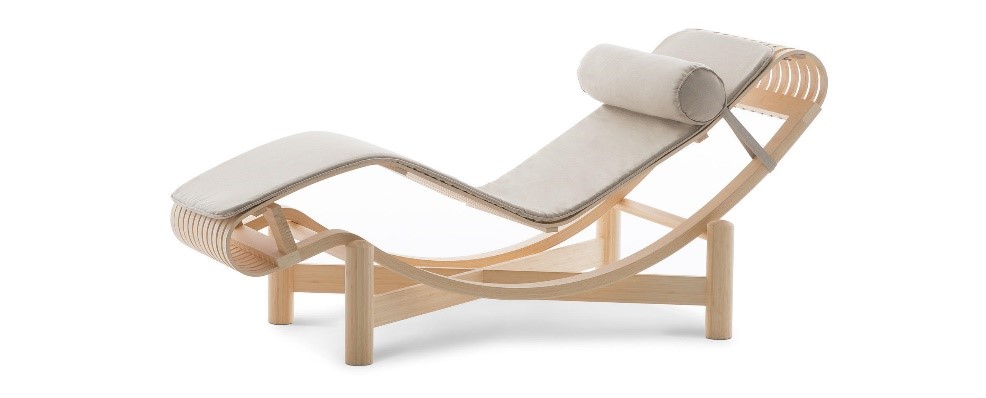
Tokyo 522 Chaise Lounge (1940), Charlotte Perriand

The Tokyo Chaise Lounge chair incorporates heat forming and bending techniques of sheets of bamboo that are mechanically joint to a bamboo structure. The form is almost exactly modelled after the B306 Chaise Lounge chair, designed in collaboration with Le Corbusier in 1928 however implements cheaper, lighter weight and more sustainable materials. The ability of a designer to progress, to learn new skills and be open to new influences while at the same time preserving important conventions is not only admirable but necessary in a world of flux. In this case, Perriand respects the way in which the chair exists within its architectural context, facilitating her vision of “harmony with man’s deepest drives and with his adopted or fabricated environment”, whilst making effective use of the clean and elegant palette and materials found in Eastern design.

Conclusion

Working ‘under the shadow’ of Le Corbusier, Charlotte Perriand has been modestly remembered. Yet her desire to design to improve people’s lives (more prominent in her later work)[4], capacity to adapt to change yet respect conventions and order makes her an exemplar of Modernist design and an important model for contemporary designers.


[1] L’Art de Vivre (1985), Charotte Perriand

[2] Charlotte Perriand: Un Art D’Habiter, 1903-1959 by Jacques Barsac. Norma Editions, 2005.

[3] From Tubular Steel to Bamboo: Charlotte Perriand, the Migrating Chaise-longue and Japan by Charlotte Benton. Journal of Design History VOL.11, No.1 (1998)

[4] Charlotte Perriand: Modernist Pioneer by Charlotte Benton. Design Museum, October 1996.

Pragmatic and cultural epithets of nature’s influence on Art and Design

Introduction

Nature has a profound influence on the human experience in general and human expression specifically. In fact, Plato claims that the artists’ works merely imitate nature[1] and do not create new nature. I would like to examine two different modes of influence – the first cultural and the second functional – that nature has over human expression within the realm of art. Lastly, I would like to demonstrate how the functional influence of nature on design has been utilised in my own personal work.

How nature can have a cultural effect on art and design

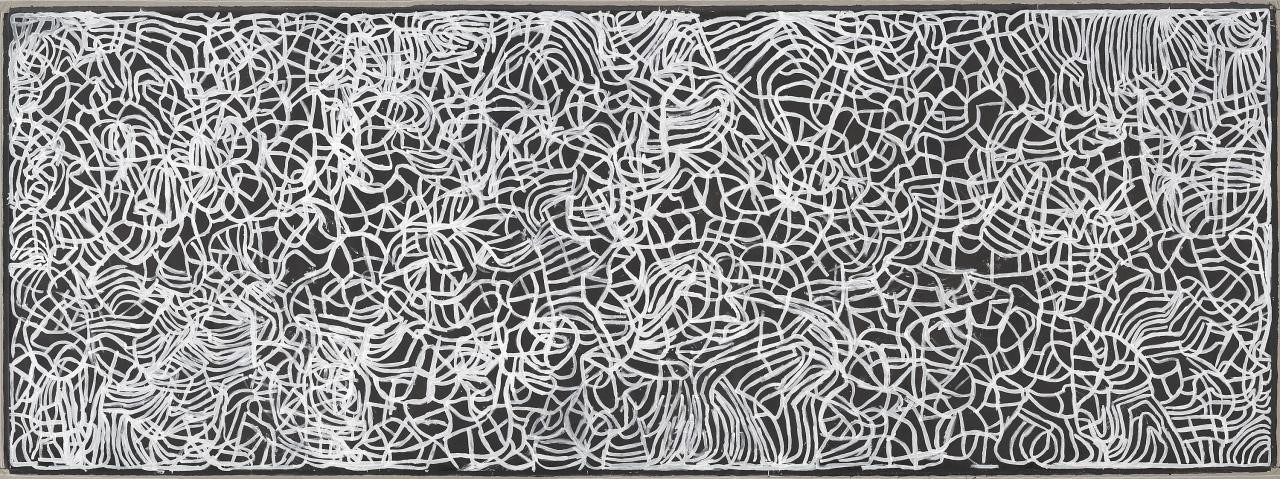
Big Yam Dreaming (1995), Emily Kam Kngwarray

Emily Kam Kngwarray’s Big Yam Dreaming[2] exemplifies a cultural-epistemological relationship with land and nature. Kngwarray’s land of birth, Alhalkere, is depicted characterised by a pre-eminence of finger yam growth through a convolutional network of underground root structures that crack and split the ground when the leaves ripen. Kngwarray does not merely depict a curious natural occurrence, but a special subjective, cultural (and perhaps sacred) relationship which she shares with the land. The continuity of the single white line set against a strongly contrasting black background lends an abstract expression of this relationship, hinting to a sort of surreal, emotional rawness that can not be described in words[3] and must be understood within the frame of her background and culture. In contrast, and perhaps ignorantly, Imants Tiller’s Terra Incognita (2005) suggests an anonymous and decontextualized relationship with the land- considered sacred and subjectively significant to so many, dryly robbing it of the specific meaning and deep history that it has to share. By implication, the cultural significance of land/nature lend far greater credence to the expressions of those connected to it and these expressions must therefore be understood vis-à-vis their cultural/historical context.

How nature can have a functional impact on design

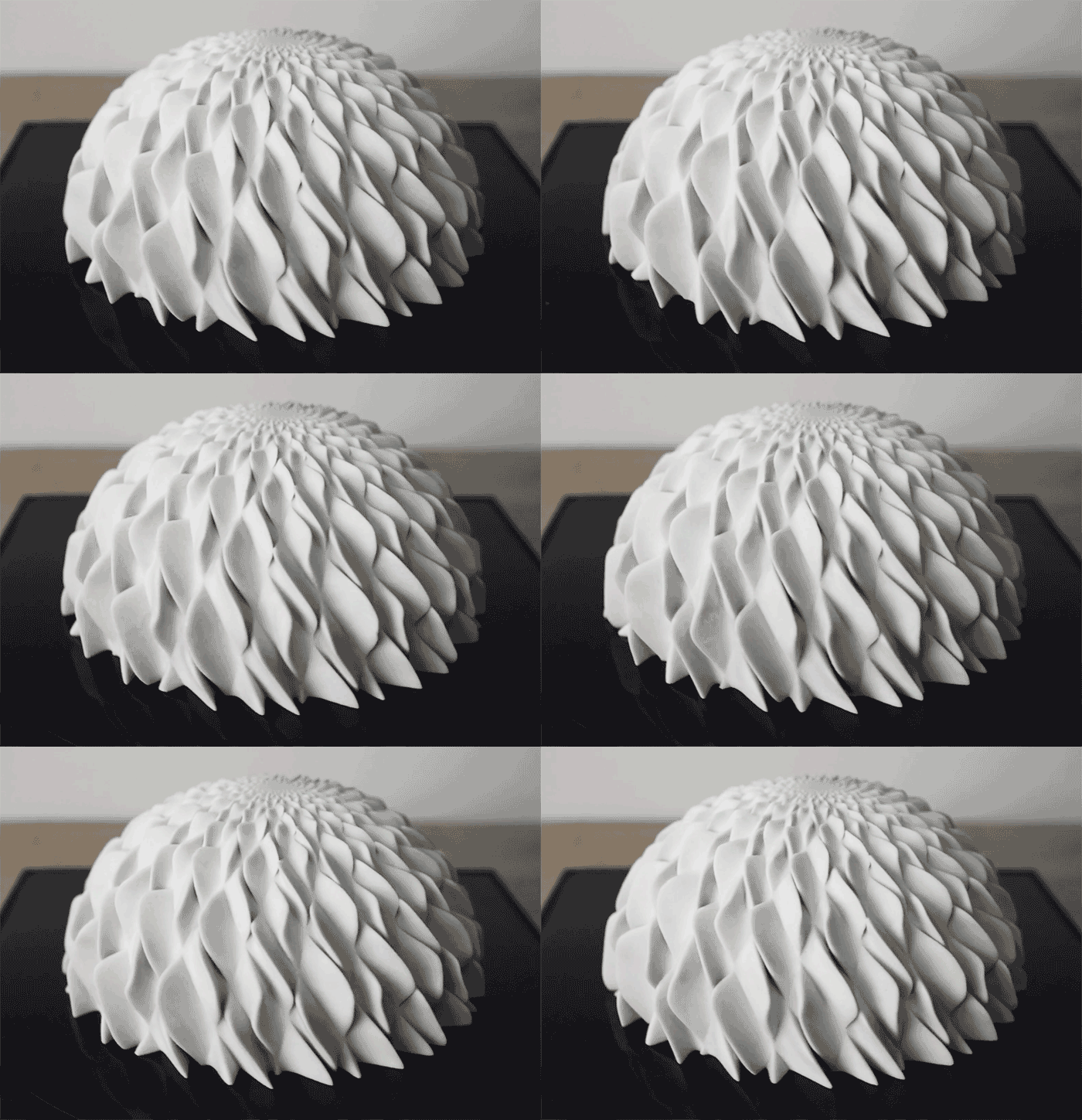
In addition to subjective/cultural meaning that nature and land-heritage can imbue art and design, there are significant functional elements of nature that can be used to better inform design processes and outcomes. Designer and computer scientist John Edmark explored this abstractly through his work ‘Blooms 2’ (2017) where he algorithmically generated a series of kinetic sculptural forms influenced by ratios found in the development of various plant-life.

Blooms kinetic sculpture (2017), John Edmark [4]

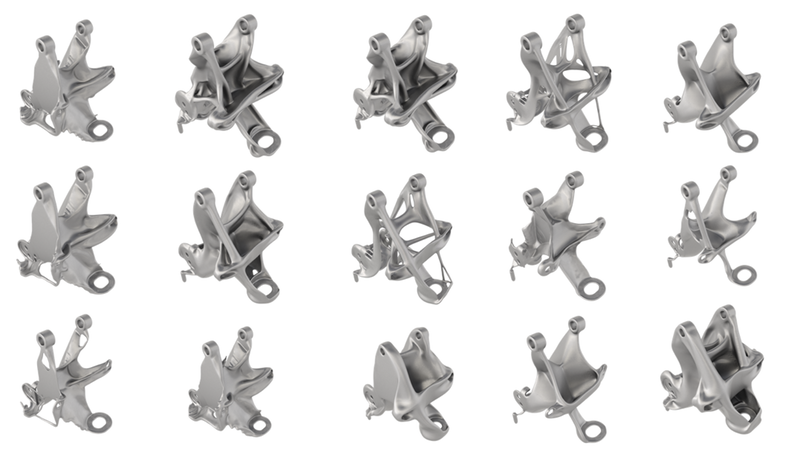
More pragmatically, researchers at Autodesk have not only looked at features in nature, but also processes, to influence and optimise design methods and outcomes. Much of this is seen through their use of evolutionary algorithms. Evolutionary algorithms, a meta-heuristic branch of machine learning, are inspired by the way in which organisms in nature with the ‘best’ traits tend to mate and pass their genes on, ensuring that the evolutionary result is most fit for survival. Similarly, these processes have been applied in computation and design, by testing combinations of different ‘traits’ (and subsequent combinations of those combinations) based on a desired goal. This method of and iterating has advanced traditional techniques based on human trial and error.

Iterating through a General Motors automotive component to balance weight and strength, Autodesk [5]

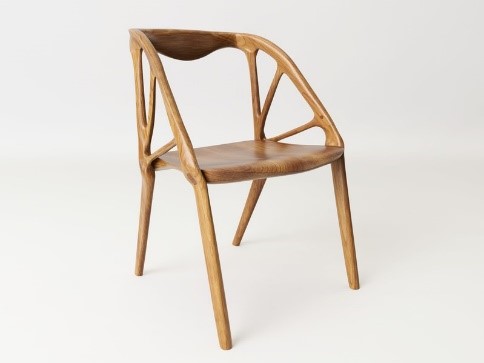
Interestingly, scientists and designers have referred back to natural occurrences in order to inform more complex technological processes that have redefined design processes. Indeed this methodology is not limited to optimising technical design but also spans the realm of aesthetics. The Elbo Chair designed by Arthur Harsuvanakit and Brittany Presten of Autodesk’s generative design lab is one example amongst others including Joris Laarman’s Bone Chair (2004) that utilises evolutionary design processes to generate unique and complex forms.

Elbo Chair (2004), Autodesk generative design lab [6]

My own application of these concepts

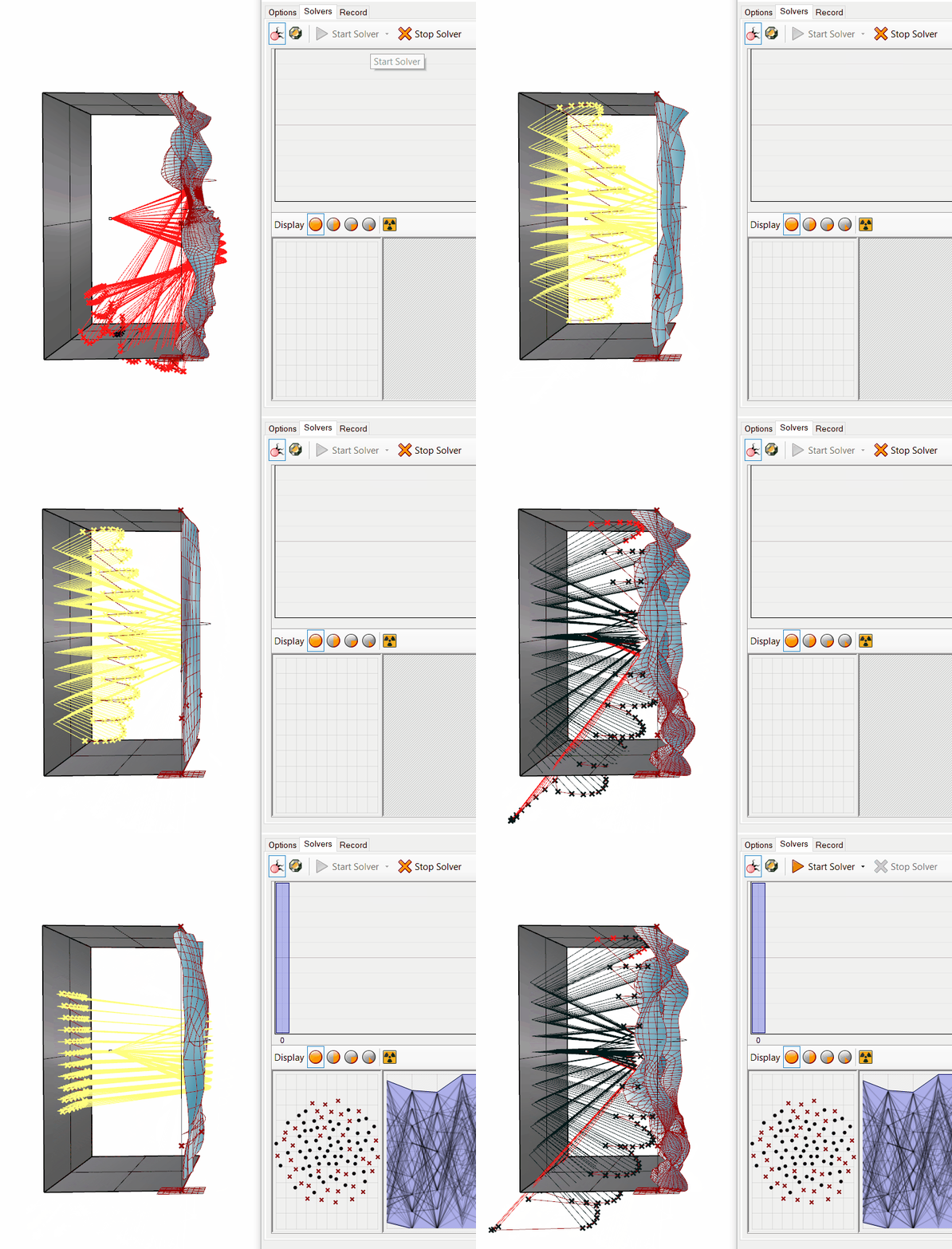
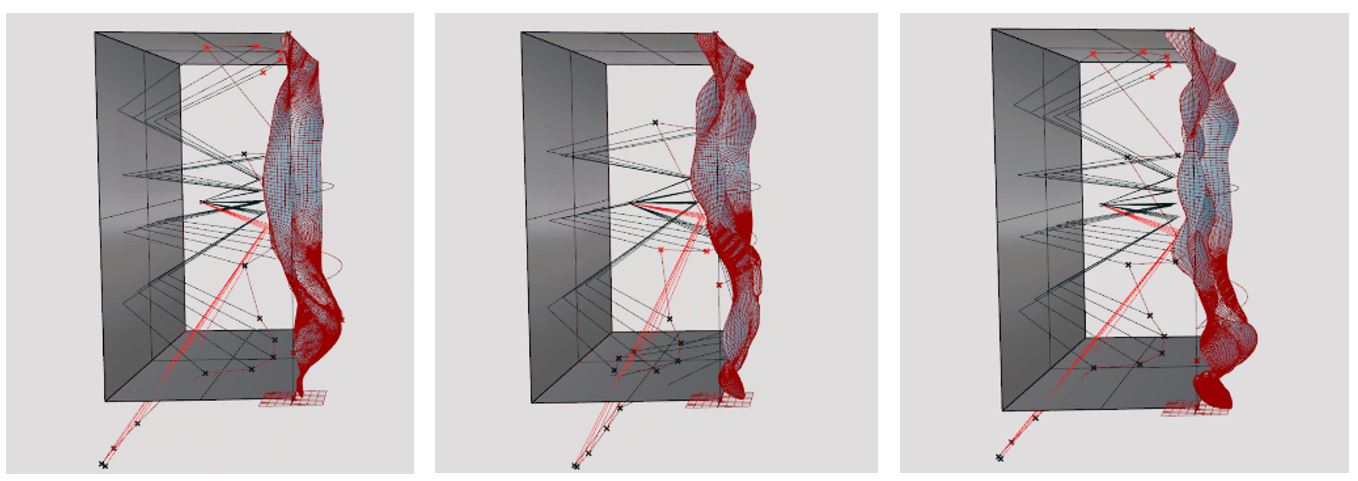
In a research piece, I too utilised generative design methods to create uniquely aesthetic and optimally functional forms, combining my IT and Design skillsets. A collaborative project that I undertook sought to generate acoustic panels that would optimally diffused and absorb sound, reducing echoes in a room and at the same time providing a compelling aesthetic that could be manipulated by the user. The algorithm took a sound-point and attempted different variations of the surfaces, measuring the effectiveness of transformations by the extent to which they diffused the ‘virtual sound waves’, resulting in a generative surface that could be milled out of foam. Having a computer create a form based on a set of biases truly follows Louis Sullivan’s famous axiom that “form follows function”, much like it does in biological systems.

Optimisation process- using an evolutionary solver to guide surface to best diffuse sound in the given space.
Acoustic panel optimisation iterations

How my work reflects a different relationship with nature

Indeed, unlike Kngwarray’s deep, heritage-based relationship with nature, mine is purely an external admiration as a pose to a cultural-historical immersion. I look at elements of nature than I can derive rules from and solve problems with and utilise them within my own methodology. Contrariwise, Kngwarray seeks to replicate the nature that she experiences due to its inherent sentimental value. (Notwithstanding the fact that I have my own cultural-national relationality with other lands and do not adopt the distant and sterile position about land and nature ad-infinitum.)

Remarks

We have briefly looked at two ways of learning from nature, the first a sort of abstract cultural-historical way determined by the relationality between people and their land and the second, an attempt to replicate rules in nature and to use the same methods to solve complex-yet-enabling design problems.


[1] Plato’s Republic, book X. See Sydney Phillip’s ‘Defense of Poesy’ for a strong counter.

[2] Kngwarray, E.K. (1995).Big Yam Dreaming. Retrieved from: https://www.ngv.vic.gov.au/essay/kwementyay-kngwarreyes-big-yam-dreaming-2/

[3] Ryan, J. (May 27, 2014). Kwementyay Kngwarreye’s Big yam Dreaming [Blog post] Retrieved from https://www.ngv.vic.gov.au/essay/kwementyay-kngwarreyes-big-yam-dreaming-2/

[4] Edmark, J. (2017). Blooms 2. Retrieved from http://www.johnedmark.com/

[5] Dannob, B. (May 3, 2018). How GM and Autodesk are using generative design for vehicles of the future. Retrieved from https://adsknews.autodesk.com/news/gm-autodesk-using-generative-design-vehicles-future

[6] Harsuvanakit, A. Presten, B. (2004) Elbo Chair. Retrieved from https://www.wired.com/2016/10/elbo-chair-autodesk-algorithm/

Forgotten hero

With the improvement of education level in society, designers become getting more attention by people, however, most are known as male designers, female designers are always be considered marginal as the influence of patriarchal society. Industrial design is often be seen as a male-dominated industry, although there are some outstanding female designers, they might be forgotten as the social impact.

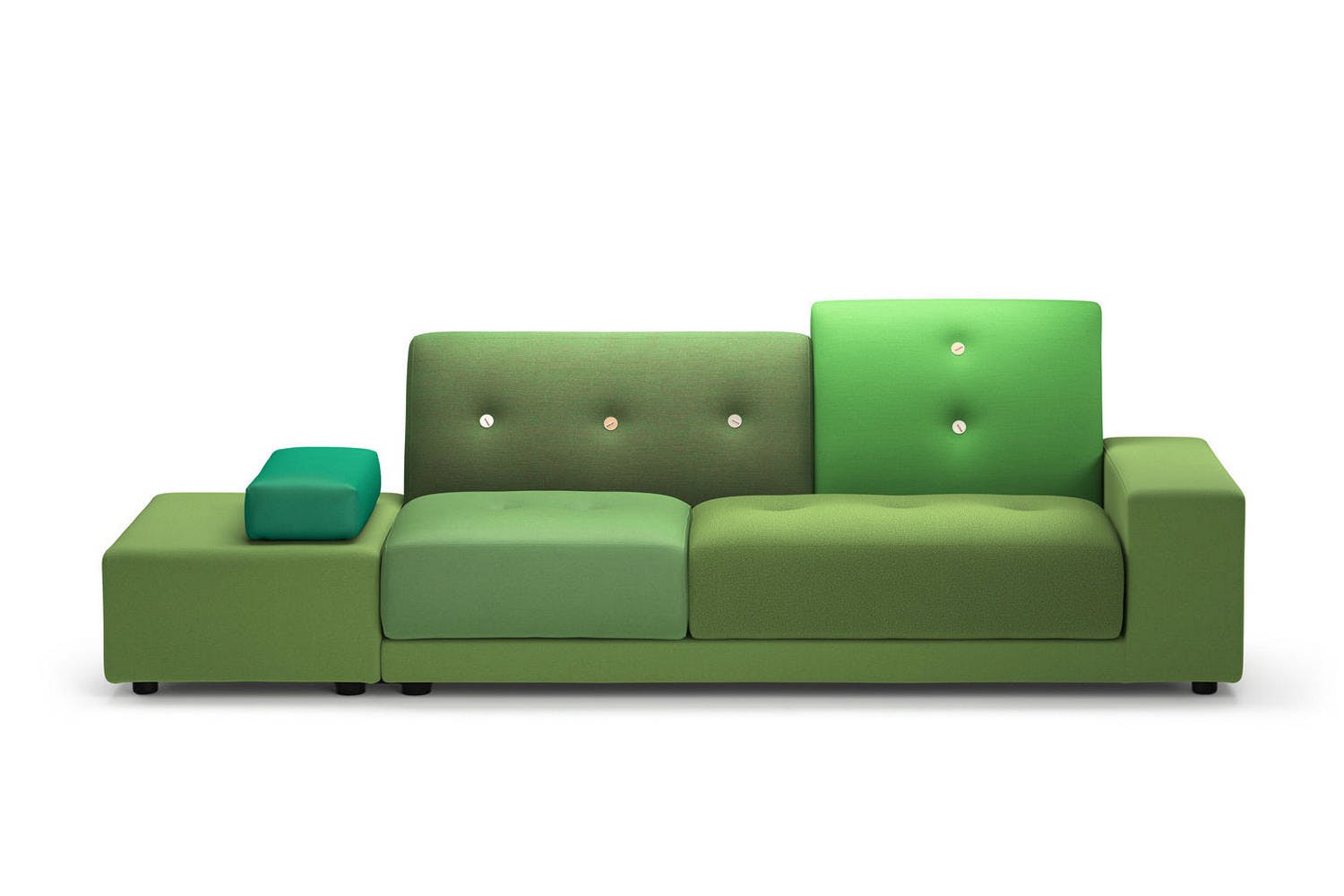
“The Polder sofa” (figure. 1)is one of the well-known design of the international furniture company Vitra but there are only a few people may know who designed this impressive furniture. The sofa has been divided into a few parts and each part with a specific texture and pattern, green is the main colour been used but each section with a different shades of green, and finished with trailing threads and hand-sewn buttons. [1] It is a well made product and ready for mass produce. Hella Jingerius, is a female designer based in Berlin, she was obsessed by the texture of handmade objects and exploring the associations between industrial design and craft process and “The Polder sofa” was designed by her, she is good at designing products with rich colour palette which is a sort of rare ability in common industrial design practice. In this case, it does not means the common product designs with bad taste of colour, the issue is most of the industrial designers prefer to stay in their safe zone that the invariance of the colours they used in design. To change that status of contemporary industrial design, Jingerius came up with her thoughts that utilise natural variations in colour sensory to improve current design. [2] And this sofa also identity her design theory that combine craft skill with mass produce as bring artistic standards into the industrial production process is her professional policy. [3] Handmade products usually are not intend to be mass produced, but Jingerius did this well even though it is a concept that hard to achieve.

Jingerius made a significant contribution to the design world as an industrial designer that dared to put rich colours on her design and fused craft process with a standard aesthetic of industrial design. Alice Rawsthorn said: “Jongerius’ greatest achievement is bringing sensuality and sophistication to the sanitary industrial design”. [4] It is not strange that this outstanding designer has been ignored as only a few females worked in this industry. According to Margaret Bruce, there is only one woman product designer who was identified in the survey done by a research group and none interviewees could remember if any female designers were currently working. [5] This sort of situation demonstrates the tough environment that female designers work in in industrial design, not only the quantitative difference between female and male industrial designers, but also social ideas of contempt for women caused this situation. In fact, most of people think women are not able to work in furniture design or wrought-iron as they question female designers’ ability. [6] As industrial design is known as a technical and dirty area, which is a sort of masculine work, people think this is not suitable for women. Furthermore, the disapproval from society to female designers and suspicion of their competence is a part of the reason production engineers refuse to communicate with female designers. [7] This sort of stereotype makes it very hard to survive for female designers and they gradually lose confidence.

In conclusion, society should pay more attention to the female designers’ achievements in industrial design, as one of the typical examples to demonstrate women designers has been placed in the margins.  Although Jingerius did some incredible innovation in this world, people may not pay attention to her as they think women are not able to succeed in the industrial design world. None of the achievements are decided by sexuality, and neither does any sexuality specify a career. Realising female designer’s contribution to the design world, especially in industrial design, is a part of the development of society.

Figure. 1 The Polder Sofa by Hella Jingerius forVitra, 2005/2015

[1] Sellers, Libby. 2017. Women Design. London: Frances Lincoln, imprint of The Quarto Group.

[2] Pearce, Margaret, and Lācis, Astra. The Misfit. 1984. Kenthurst [N.S.W.]: Kangaroo Press.

[3] Sellers, Libby. 2017. Women Design. London: Frances Lincoln, imprint of The Quarto Group.

[4] Rawsthorn, Alice. 2010. Daring to Play With a Rich Palette. The New York Times. 4 March 2014.

[5] Bruce, and Lewis. 1990. Women Designers: Is There a Gender Trap? Design Studies 11, no. 2: 115.

[6] Ibid, 116.

[7] Ibid, 118.

Welcome to Wasteland Bessar Space Collingwood

War on Waste

We have reached that point. We are frequently throwing away excessive amounts of food, clothing, appliances and plastic packaging that our waste is growing at a faster rate than that of our population. How can this be sustainable? 

These problems of toxicity, pollution and waste in our society were a key theme of the Welcome to Wasteland Exhibition (14-24 March), which was held in relation to the Melbourne Design Week program.

Welcome to Wasteland showcases projects by various creatives – including architects, industrial designers, graphic designers and researchers – to explore the use of waste materials and offer visitors an insight into how leading practitioners are challenging Australian waste issues [1].

Aerial top view large garbage pile by Kalyakan

This theme draws upon the perspectives made by anthropologist Mary Douglas on dirt and culture. For Douglas, every society has some concept of dirt which is relative to its circumstances and needs. She highlights, “There is no such thing as absolute dirt.” What she is accentuating is that almost anything can be considered dirt if it is in the wrong place [2].

However, there will always be things that do not quite fit in, and they will be seen as either ‘dirt’, ‘waste’, ‘by-products’ or ‘pollution’. Thus, some kind of forward thinking is required in order to create value and meaning from materials that might otherwise remain ordinary and neglected.

Turning Trash into Treasure

The Welcome to Wasteland Exhibition challenged designers to ‘Make a statement. Make a difference’. It was time to step out of conventional practices and many designers embraced the concept in their works as they pushed the boundaries. But none on display caught my eye as much as the CMYK Chair by Morgan Doty.

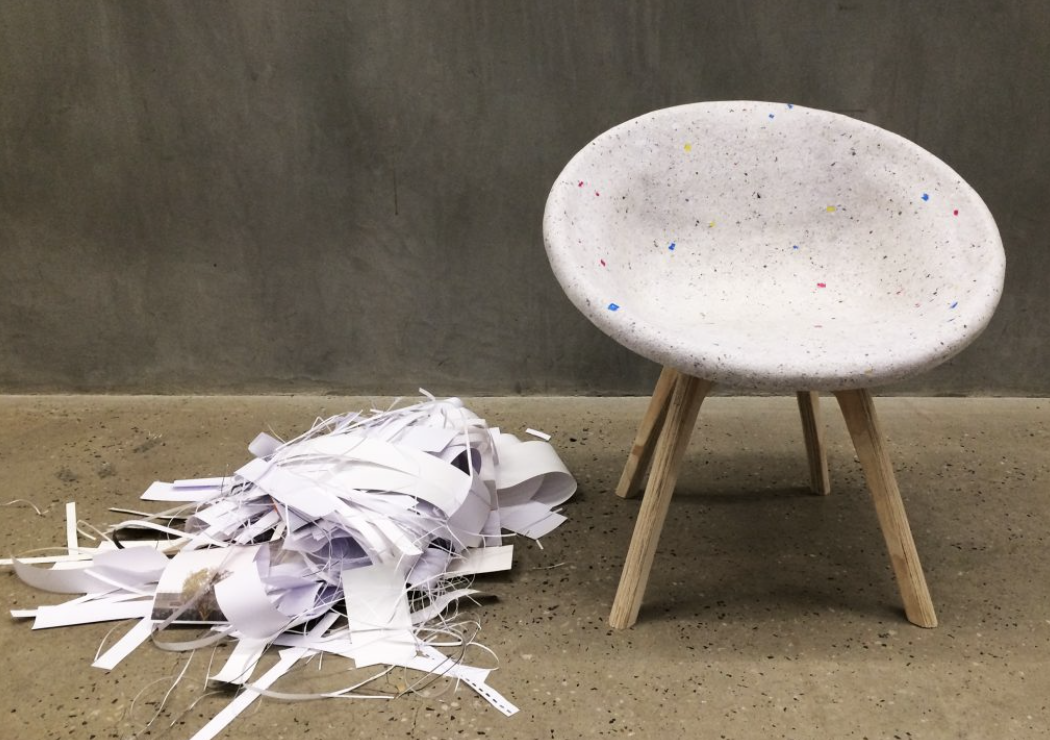
Morgan was inspired by picking a material and process which would push the limitations of re-using waste materials. Her design explores the recycling of shredded paper pulp which was moulded over a CNC cut form. The chair uses double curvature and ribbing to create a very strong and comfortable shell structure. But when I took a closer look at the materials she used, it virtually told its own story of the magazines it is made from that were collected across the University of Melbourne Campus. 

According to Morgan, “It was important to get the mixture right to showcase the texture and quality of the material” [3]. What is interesting is that her design was never intended to be what it is now – a chair. The form was determined by testing the process to understand the durability and the strength of the material. Once the form was a double curvature and shell structure, turning it into a chair made sense using recycled timber [4]. This goes to show that sometimes seeing the beauty in an inconspicuous piece of rubbish can open our minds to many different possibilities.

CMYK Chair by Morgan Doty

Despite being in her final year of tertiary education, the experience has shifted Morgan’s perception on design. “I loved how this was a balance between making and architecture and it is something I’d love to do more of in the future.” Morgan then went on: “Making makes you think a lot more about the design because you have to ensure it can viably become physical” [5].

This outlook is innovative. Instead of focusing on the threat of waste, Morgan has been able to interpret and display how waste can be used to solve other problems. She has effectively considered the situation as a glass half full, rather than a glass half empty. 

Imagination is core to these ideas. It is essential to imagine things differently if we are to start to think our way out of these problems. Together, the design community may just create a new way forward in this rapidly changing world. 

References

[1]https://greenmagazine.com.au/welcome-to-wasteland-an-intimate-chat/

[2]https://www.domusweb.it/en/design/2019/04/04/absolute-toxicity-review-of-me lbourne-dsign-week.html

[3]https://msd.unimelb.edu.au/news/morgans-cmyk-chair-takes-out-a-suite-of-melbourne-fringe-furniture-awards

[4] Ibid.

[5] Ibid.

Exploration of contemporary jewellery

With the fast developing society, jewellery has been endowed a distinct value in modern society. Jewellery had been seen as gems in traditionally, the precious value determined to become a representation of identity that able to decide a person’s position in social hierarchy. The jewellery status in modern times extend as an association between itself and people, it will not just an object when someone wearing it. Contemporary jewellery started as a movement among makers seeking to record what jewellery is and how it can express value. [1] Makers desire for exploring jewellery as an experience and a performance making visible its vital relationship to the body, the notion of them is jewellery could reachable by anyone. [2]

Susan Cohn is a jeweller and designer based in Melbourne, she is captivated by the interaction between design and jewellery and attempting to find out how to help people define their place in the world in terms of using jewellery that have an association with them.

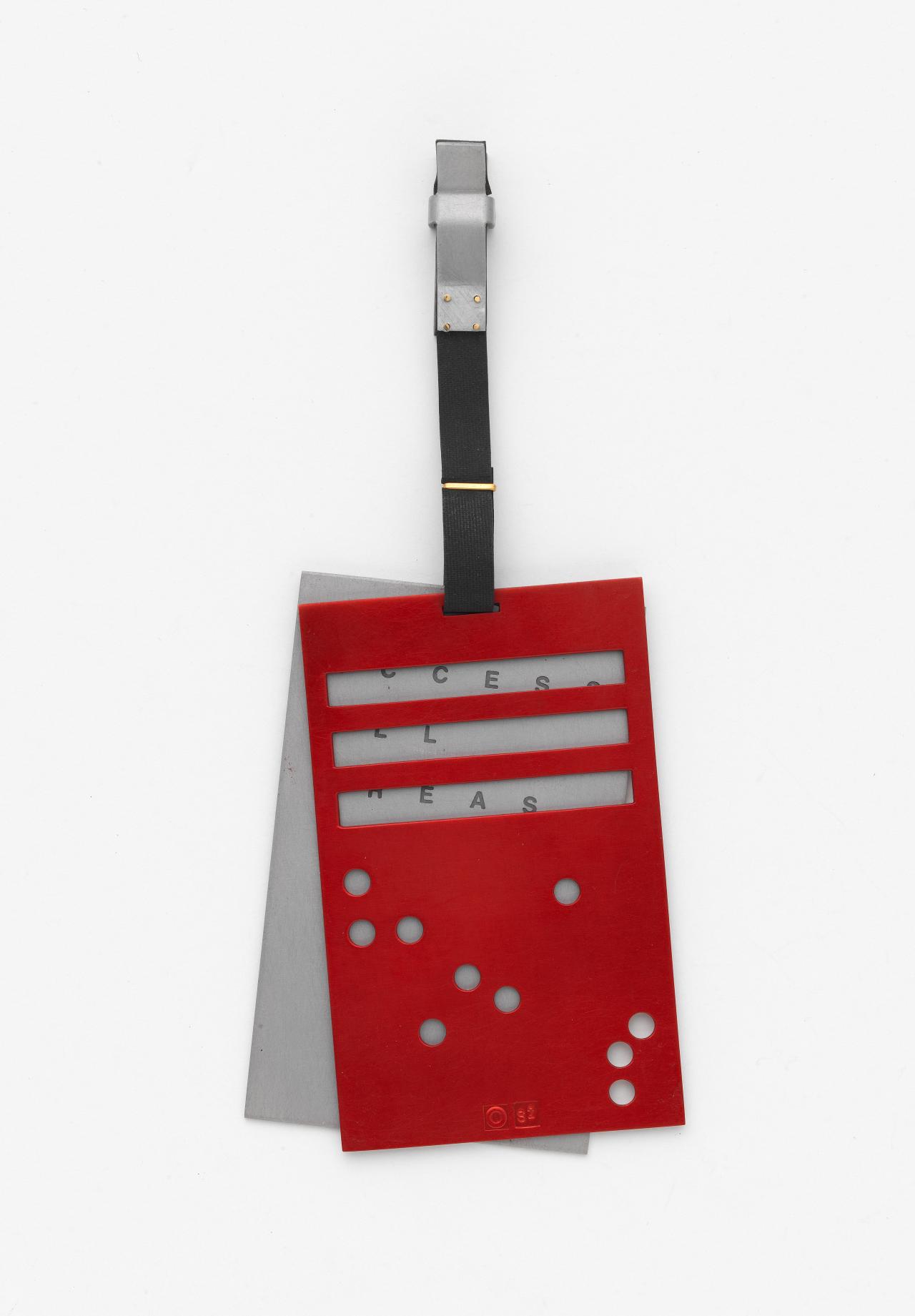
“The Security Pass” (figure. 1) is one of Cohn’s works which exhibited in the Design Women exhibition at the National Gallery of Vitoria, this exhibition is about showing some outstanding works made by female designers. “The Security Pass” is not like traditional jewellery which has well-made metal card appearance. The front red piece has a few hollow spaces on in terms of allowing people to see the text on the back piece, it said: “access all areas”. Two pieces are connected by a rubber strip with a metal clip. In this work, Cohn explored the social meaning of the everyday object in people’s daily life without its functionality, the ID tag is often worn by people as a part of their job, however, considering its worn as jewellery on the body, apparently could be a personal ornament then it is able to speak to people, every mark on it tells the story of wearer, and there is a relationship has been built up between the security pass and wearer. The security pass design usually with a simple design which makes the wearer have an official and professional look.

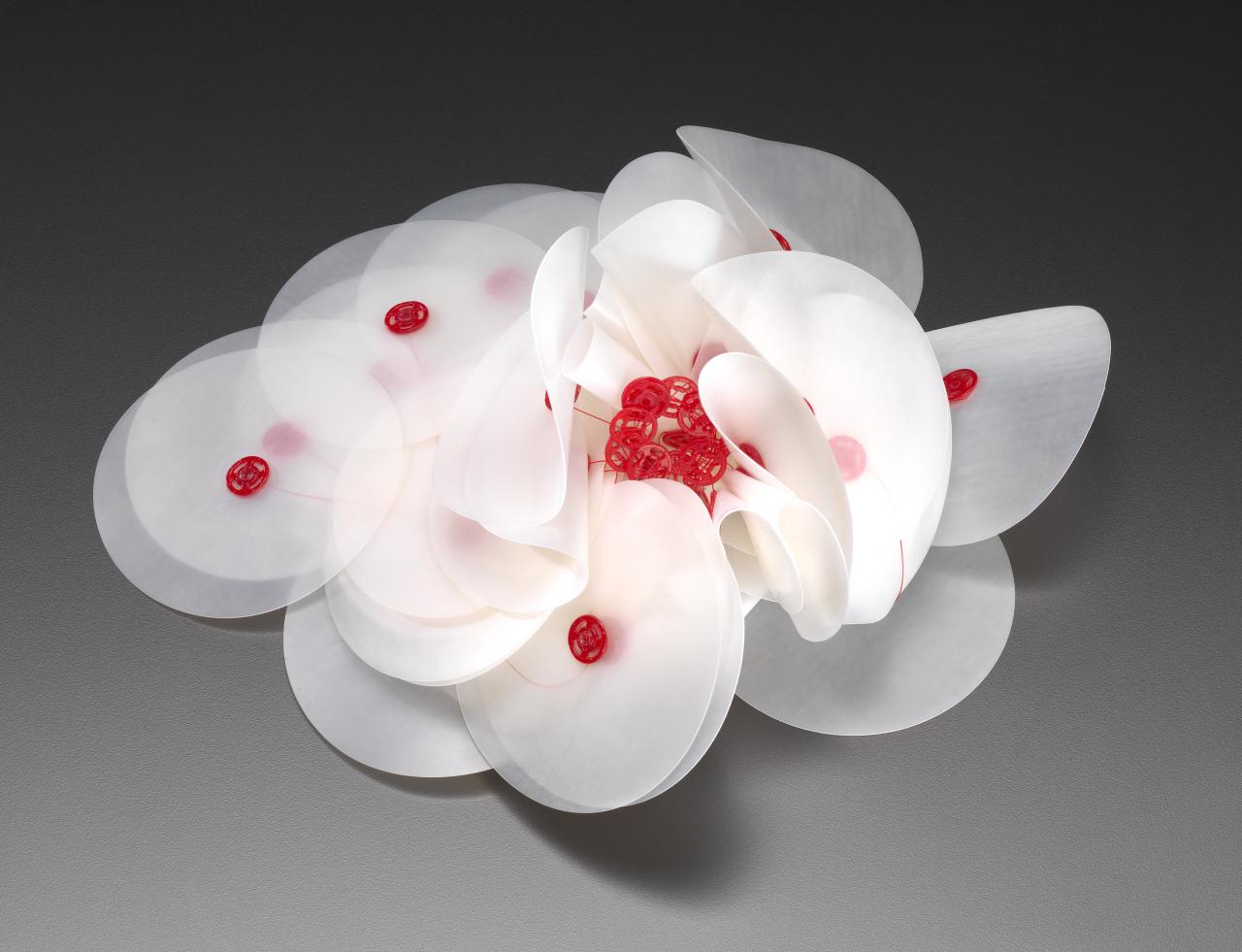
Similar to Cohn’s work, “ MEGA, ring” (figure. 2) is another unconventional jewellery made by Camilla Prasch, the high-tech ruffles of the Mega ring is made of red-dyed snap fasteners, nylon thread and silicone discs. This bracelet was shown an exploration of the theme in contemporary jewellery that the use of logic for a system of components.[3] Prasch turns some subtle object in common life into a piece of large jewellery in terms of highlighting the meaning behind them as jewellery. In this work, the association between jewellery and human body also has been shown, the wearer will get aware of the existence of these subtle kinds of stuff in the life, they may not have any functional purpose, but they start to get meaning when they have been worn. People are surrounded by these sorts of subtle pieces of stuff all the time, but they have never noticed them. Prasch made them have the ability to be worn as well as putting fashion value on them. In Cohn’s work, the security pass is intended to be worn, not only as a functional card but also as a piece of jewellery, however, Prasch’s bracelet is not intended to be worn before made, the meaning and wearability will take place when they have been put together.

Another important meaning of contemporary jewellery is to send the wearer’s signal to the world; this is similar to jewellery’s traditional function, which is to demonstrate the wearer’s experiences and social status. For instance, Madeleine Albright who was well-known as the first female United States Secretary of State in U.S history, was a jewellery collector as well. She would wear a particular brooch from her collection of brooches to send a message or show her attitude to other people on diplomatic occasions. “The Security Pass” and “MEGA ring” pieces of jewellery are both intended to send a signal to exhibition visitors, the ID tag sends a piece of information about authority and the ring is about uniqueness. In the design aspect, they both are a good design with good taste, the high-quality design outcomes show two artists’ craftsman-skill and competence. The meaning and exploration behind these two works demonstrate they have good taste. Plato’s thesis about good taste was that the ideas are more important than actions, the design must have content instead of just a gorgeous appearance, and the thought behind the design is more important than its actual creation. [4] The artists are making a significant impact on the development of contemporary jewellery, not just showing the basic theory, but expressing an innovation which clarifies the reason of why they should be defined as a good design with good taste.

In conclusion, “The Security Pass” and “MEGA ring” both demonstrate using innovative materials and design technique as a part of jewellery that explores the definition of jewellery further and shows a good design practice in the development of contemporary jewellery, these two artists fusing unusual materials with definition of traditional jewellery  to deliver a brand new concept to the world and enhancing people’s understanding of jewellery.

Figure 1. The Security Pass by Susan Cohn, 1989.
Figure 2. MEGA ring by Camilla Prashch, 2009.

[1] Cohn, Susan, Sudjic, Deyan, National Gallery of Victoria, and Design Museum. 2012. Unexpected Pleasures : The Art and Design of Contemporary Jewellery. New York: Rizzoli International.

[2] Ibid.

[3] Ibid.

[4] Christoforidou, Despina, Elin Olander, Anders Warell, and Lisbeth Svengren Holm. 2012. Good Taste vs. Good Design: A Tug of War in the Light of Bling. The Design Journal 15, no. 2: 188.

From Bark to Neon

From Bark to Neon

The From Bark to Neon exhibition which is held at the NGV in federation square is an exhibition showcasing old style aboriginal art as well as new style neon inspired artwork. The exhibition that consists of 4 main rooms rooms as well as corridors lined with intricate and colourful artwork, each telling their own story brings the spaces to life. The exhibition was one in which I had never experienced before as in the past I have usually had no interest in Aboriginal art, going into the exhibition I was looking to change that and gain some insight into the type of art. Containing new pieces as well as some older pieces the exhibition was bustling with people in every room, surprising seeing as it had been around for around 8 months prior to me visiting. The exhibition had an extremely systematic flow which was enjoyable as it really showcased the progression of the type of art that was shown as well as progression away from traditional forms into more abstract means. 

The exhibition consisted of many different methods and media and this variety was exciting to the eye. The way that the exhibition flowed from start to end, from the original applications of aboriginal art such as paint on canvas to a print on clear acrylic moving onto neon sculptures, the exhibition really expresses the meaning of its name ‘From Bark to Neon’. One thing that was exciting about the art to me was the sheer amount of colours and how it bought the walls to life showcasing intricate skill and shows the care that the artist has put into every stroke on every piece. As the exhibition became more abstract the art still showed a large amount of care and planing to what may be seen by some as careless or rushed strokes. Regardless the talent and thought that was put into every piece was truly admirable.

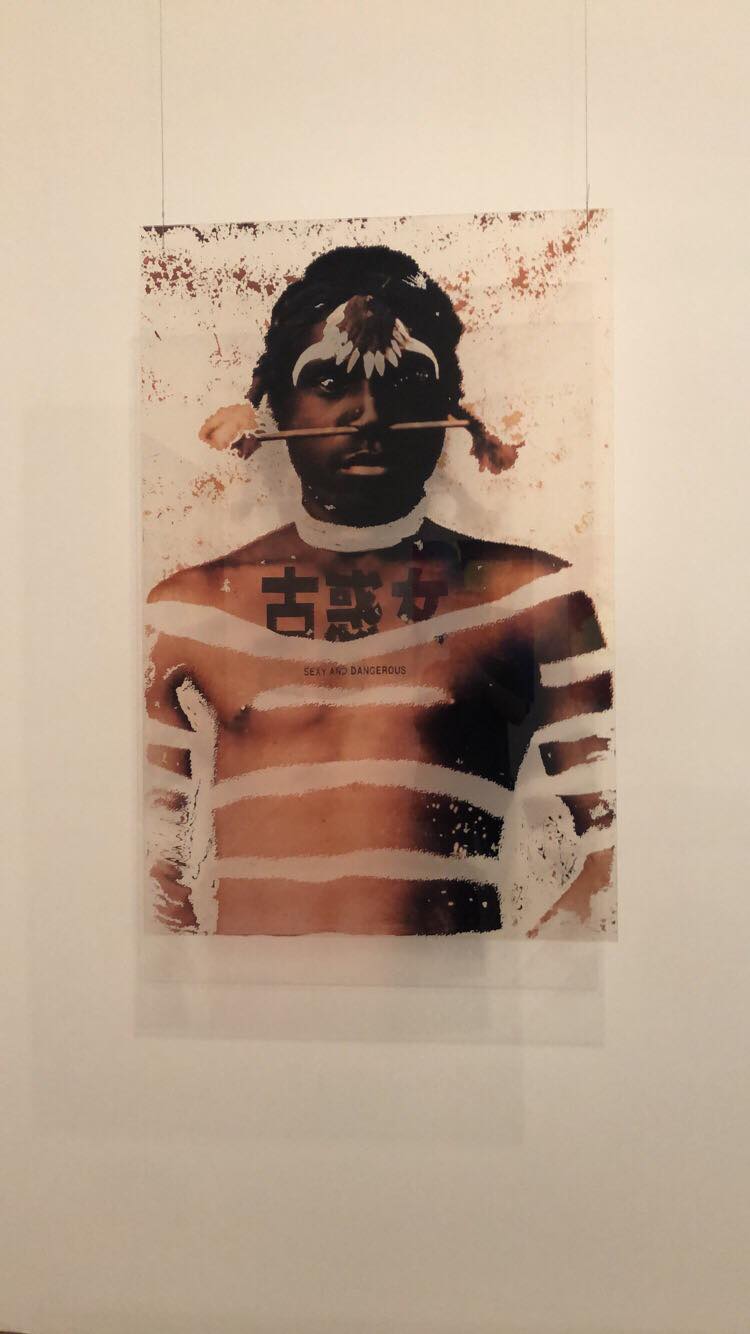
There was many exciting and interesting pieces that grabbed attention, ranging from painting to sculpture. The eye was being drawn to many interesting and exciting pieces however there was one that stood out to me, this piece being a photo on a piece of clear acrylic called “Sexy and Dangerous” [1] which was produced by Brook Andrew, a photo taken in 1996 by Charles Kerry and produced into this piece of art in 2005. I really enjoyed the mix of showing the aboriginal person portraying a ‘sexy and dangerous’ image in an attempt to replicate a billboard campaign. Although the subject that is being advertised is unclear it is more about portraying an image that the photographer portrayed at the time. The application method of print on clear acrylic really allows for the image to somewhat pop off the wall and show the image of the tattooed man with the spear through his nose. The graphic having no background other than some artistic colour allows for no confusion around the subject of the picture besides the man with the ‘sexy and dangerous’ tattoo across his chest. In my opinion this piece was the best one there not only because of the imagery used but as well as the application it was presented.

Although the name suggests the evolution of aboriginal art from ‘Bark to Neon’ it is evident that this is only a metaphor for the progression and direction as well as the evolution that aboriginal artwork has taken, and where it will be going in the future. With limited ‘neon’ pieces in the exhibition the neon aspect of the name was overturned by sculpture which really allowed the audience to view the progression of the art form. As well as that the use of digital media in pictures and the use of vibrant colours that transitioned away from the expected pallets of the more older aboriginal artwork were truly showing the direction that the artists are going in. Transitioning away from traditional media however still letting their aboriginal heritage and influence show through predominantly in every piece, creating an identity for each piece that is extremely clear. It truly is an amazing style of art that allows not only story telling but artist expression as well as education on the past and present people in the aboriginal community.

Upon visiting the exhibition I truly gained an understanding and appreciation for Aboriginal artwork and really enjoyed and am excited for the progression that its making. I highly recommend visiting the exhibition to anyone else who wants to further their knowledge about aboriginal art as well as anybody who already has an interest in this style of art. Not only was it an art exhibition it was also an education about the native people of the land and through this art it was a chance for them to convey their story. It is important that this art continues on for years to come to ensure the history of Aboriginal Australians is solidified.

[1] Sexy and Dangerous, Brook Andrew 2005, From Bark to Neon (NGV) Visited 1/4/19

Marc Newson – Forgotten Hero or Secret Father of design

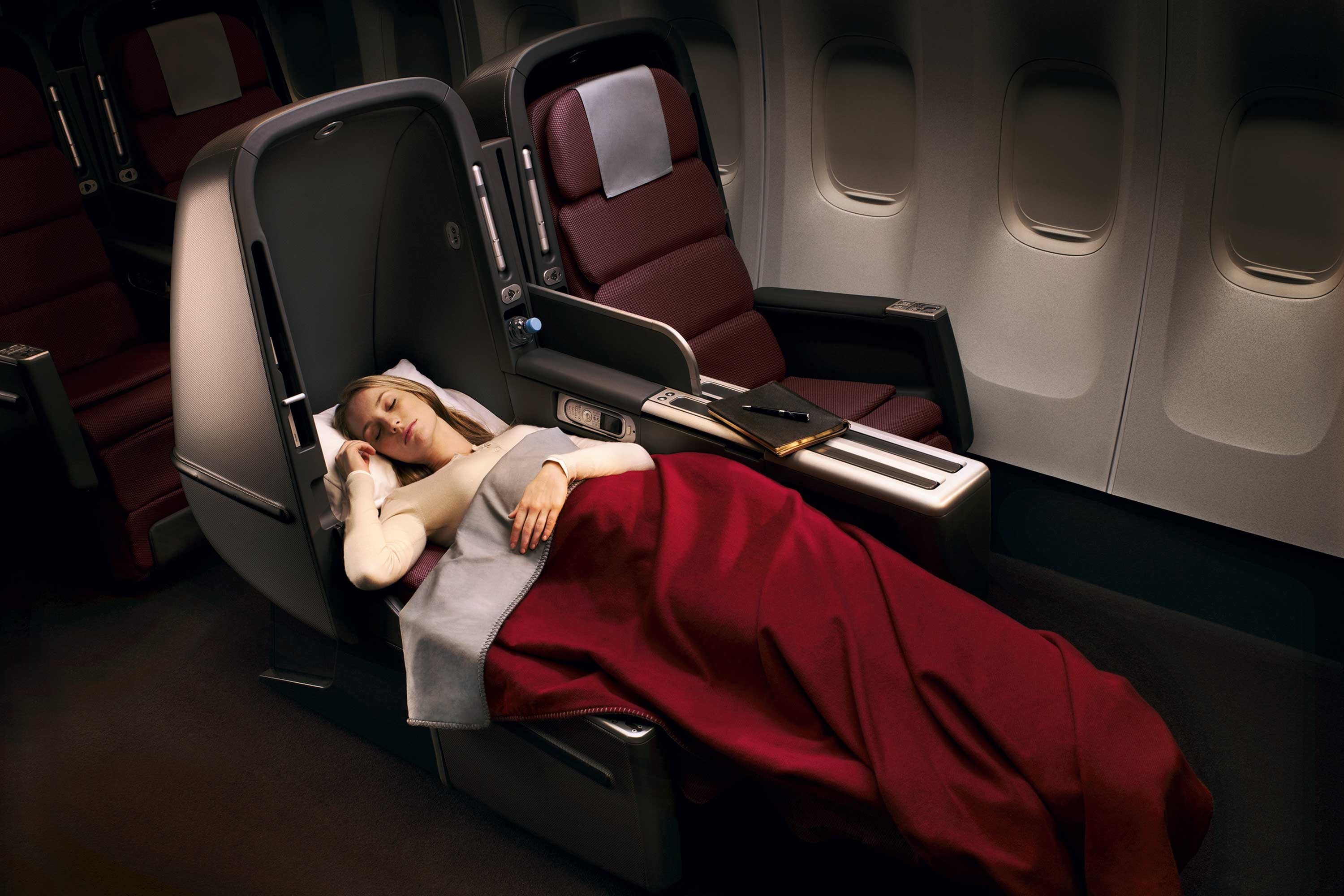
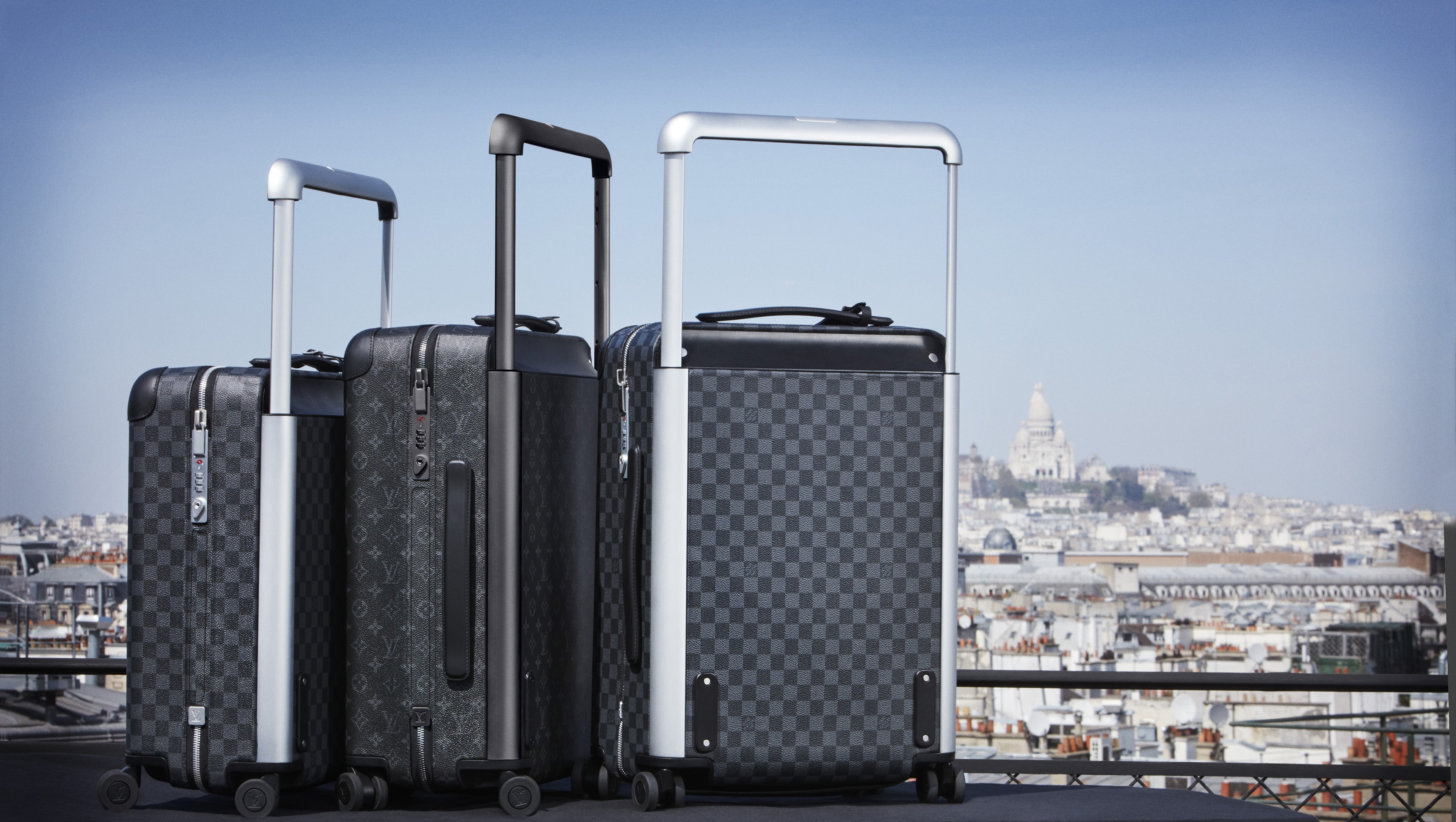
To be considered a ‘hero of design’ would be a feat for any designer regardless of geographical location, to be considered one coming from Australia would solidify your name in design history. With a lack of notable designers coming from a land with is seen to be somewhat backwards in their contribution to design making a name for yourself and placing yourself next to design royalty would truly be amazing. Sadly this is not the case for Marc Newson, to many a name that has been taken away from many amazing and great designs only to be replaced by a brand. Marc Newson was born on the 20th of October 1963 in Sydney Australia. In 1984 he graduated from the Sydney College of Arts, specialising in Jewellery and creating sculptures. Newson has worked on many things in the design world that have been seen such as the Qantas Airbed (pictured below) [1] which went on to win the 2009 Australian International Design Award of the Year. Although Newson has many credentials he can be considered a lost hero of Australian design due to the fact that he doesn’t put his name on his designs as the companies that he designs for put their branding on it. Newson has worked for a plethora companies from ford to Louis Vuitton on a collaborative set of luggage cases (pictured below) [2] to Nike, creating collaborative designs and limited edition pieces that are well sought after and extremely rare to collectors as well as admired by the general public. 

Although in the design industry Marc Newson is a name that is well respected, outside of the industry it is a name that majority of people have never heard of although in many cases people may use his designs every single day. This is a classic case of the identity of the artist being stripped away by a major brand. Although Newson is often contracted to work for the brand and add his unique and extremely sought after flare to works for the benefit of companies often there is no reference to him, ultimately stripping away his image from every piece. Although Elements of Newson’s style such as sweeping edges is often incorporated in a lot of his designs his flare has been copied by many. 

From the streets of Sydney to travelling to the major design cities of the world such as Japan, America, England and Paris, Newson has really made a name for himself and to other designers is one of the fathers of modern design. With major brands knocking at his doorstep his flare has impacted many other designers and somewhat paved the way to push forward a new wave of innovation in the ever expanding industry. Undoubtedly creating as platform for emerging designers. Newson has created a quote which has been adapted by designers which is “I think it’s really important to design things with a kind of personality.” [3]. Newson’s personality definitely influences his design and helps create his image. Newson has found a way to incorporate his feelings and personality into the creation of products, however nobody but himself will know that. In the reading  A Geography of Power: Design History and Marginality written by Tony Fry he states that  “Australia has no major designer heroes of international standing, no outstanding design institutions.” [4] This was written in 1989 however helps reinforce that Newson’s personal stamp that he has left on design is is unnoticed which can help show that he is a ‘forgotten hero’

There is no doubt that Newson has had a massive positive impact in the design world. For someone who has worked with so many big brands from Nike to Louis Vuitton to Qantas he really has found a way to pave his way and cement his legacy. However at the same time he is a forgotten hero of design. This may not be the case when it comes to designers but for members of the general public who use his products on an everyday basis Newson could really be seen as a ‘forgotten hero’. His image being stripped away every single day without knowing by millions of users who consume his product. Newson could easily become an unforgotten hero by simply adding a touch such as a signature or a logo and that would be enough. Maybe part of Newson’s flare is that he is unknown and that his products just blend into everyday life, after all is that what successful design is all about?

1.http://marc-newson.com/qantas-a380/ Accessed 1/4/19

2. http://marc-newson.com/rolling-luggage/ Accessed 1/4/19

3. https://www.brainyquote.com/quotes/marc_newson_278940 Accessed 2/4/19

4.  A Geography of Power: Design History and Marginality, Tony Fry, 1989 Accessed 2/4/19

The Slight Leap From Art To Design

In the Journal article, Transformation of the Aesthetic: Art as Participatory Design, by Matthew Holt, Holt asserts that there has been a long standing connection between art and design, and that it is a bridge so short that many artists jump from one side to the other with little effort. There have also been writers such as Alex Coles that have discussed this closeness in detail. Coles coined the term ‘designart’ to describe this grey area between the two fields.[1]

While most of Holt’s article focuses on participatory projects acting as a bridge between art and design, I would argue that this is not the only necessary bridge. Certainly from a design perspective travelling in the direction of an art perspective, collaborative design is a huge step towards the art side of things.

However what about approaching this idea from an artists perspective, where a piece is not necessarily created with an audience in mind at all, unlike design, it has the luxury of being almost entirely introspective if the artist so chooses. I have often indulged in selfishly ignoring what a customer may or may not purchase or relate to, in order to express my own ideas, something that if applied to design, would result in a failed creation.

But on the other side, as I have learned design, I have also learned to create a distance between myself and my work where the audience sits, and where they too have a say. This mixture of selfish and selfless creation can be jarring, but is there a middle ground between the two, aside from participatory design? Something both personal and accessible to an audience?

Callum Guy Douglas, The Dusk-trader’, 2017

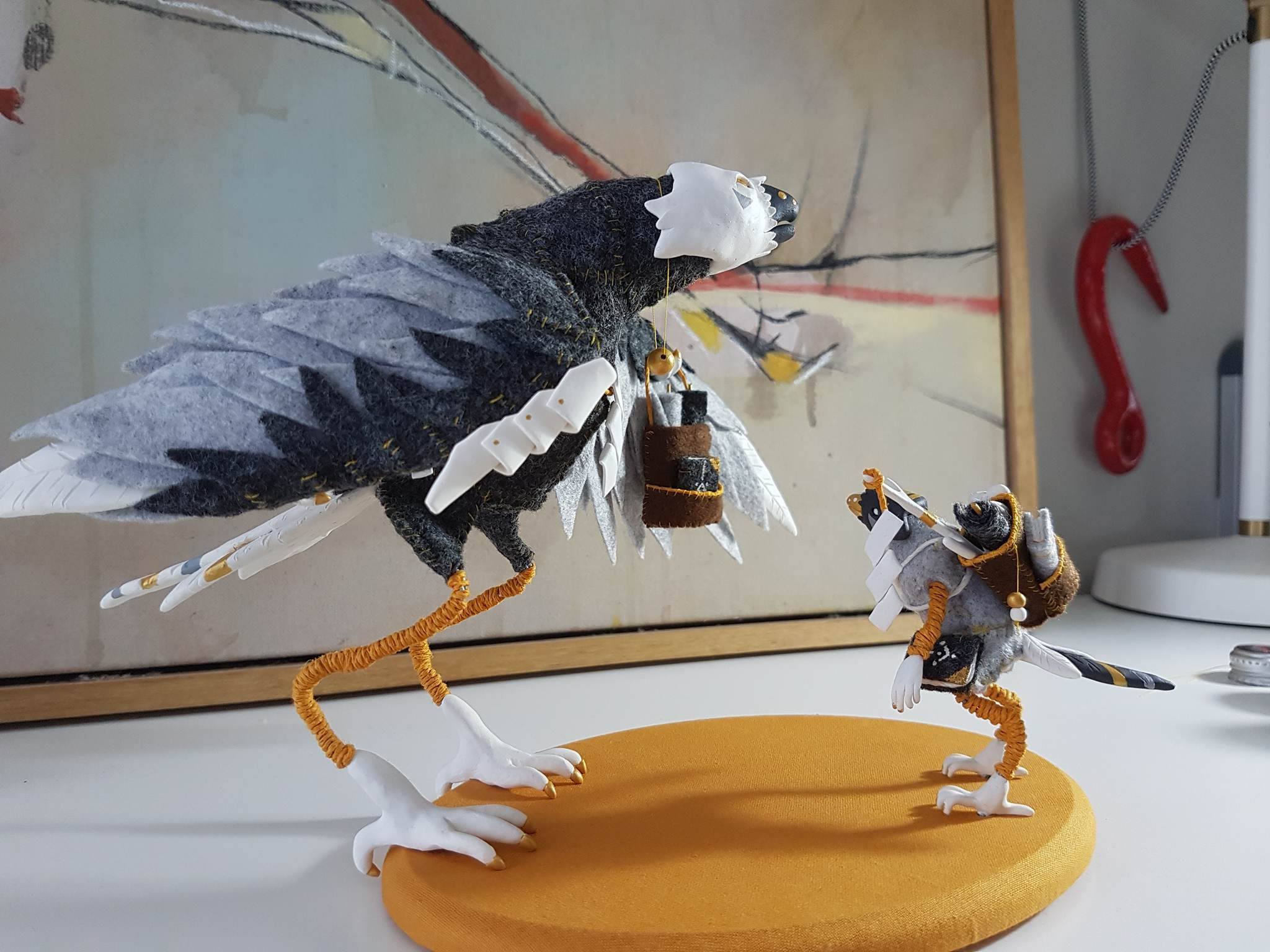
This is a sculptural work I created in 2017 called ‘The Dusk-trader’ which at the time, I would have considered a completely self indulgent piece. However upon closer thought, years later, and with a bit of design understanding, I can see that several aspects of the work could be seen as edging toward design.

Something both art and design can’t escape sharing is use of colour to create emotional responses to work. I have always stuck to a limited palette, with equal distribution across all elements. And even when creating a piece of design work, unless specified by a brief, the use of colour is always something I do for myself. Unless absolutely necessary I wont budge on my colour choices.

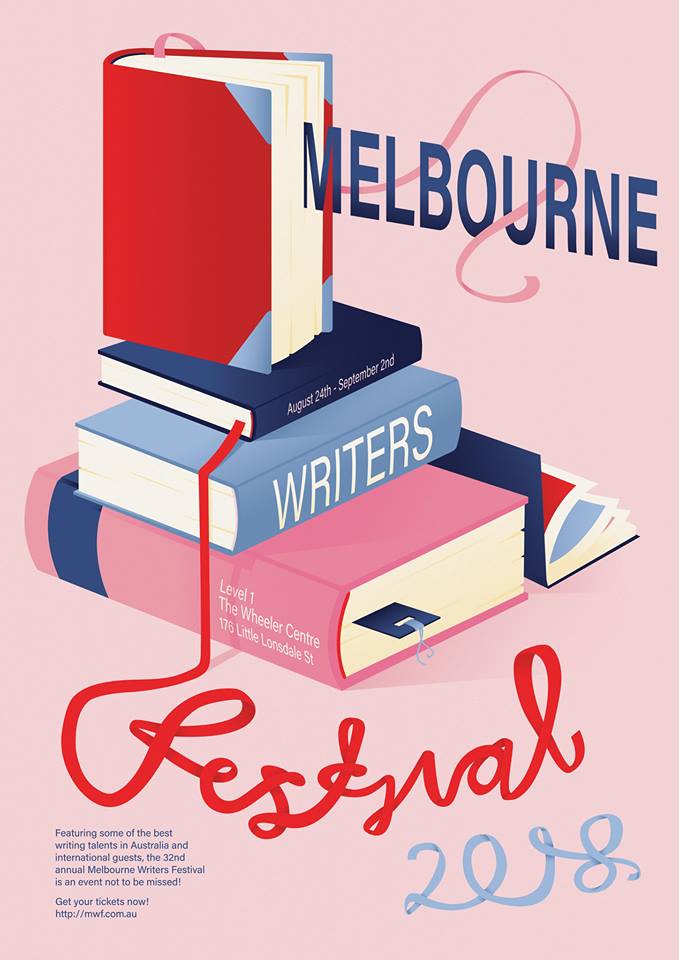
The similarities in colour distribution can be seen in this work created last year to promote the Melbourne Writers Festival. The colour, in both works, is what is used to lead the eye around the piece. The choice of colours in both circumstances were based on design ideas, in that all of the colours chosen harmonise together, and the limited palette allows for easier distribution. The colours however, are not representative of anything in particular, but where selected based simply on my feelings at the time. This is both selfish and selfless at the same time and perhaps a small way in which design and art can come together in pieces.

An artist/designer that shows how the two disciplines can be hard to separate at all is Paula Scher. She claims that ‘Typography is painting with words, that’s my biggest high.'[2] This statement shows a personal emotional reward related to the practice of design, which would otherwise usually be associated with art. Paula has been shifting between the worlds of art and design for many years, and some of her work is hard to describe as either in particular.

‘I could never walk into an office, and sit down at my desk to design’ Paula explains her method involves a move introspective experience when creating a design to solve a problem, which also reflects ways in which both and artist and designer would tackle the creative process, both selfish and selfless at the same time. It is both involving herself, and using that to solve a problem for someone else.


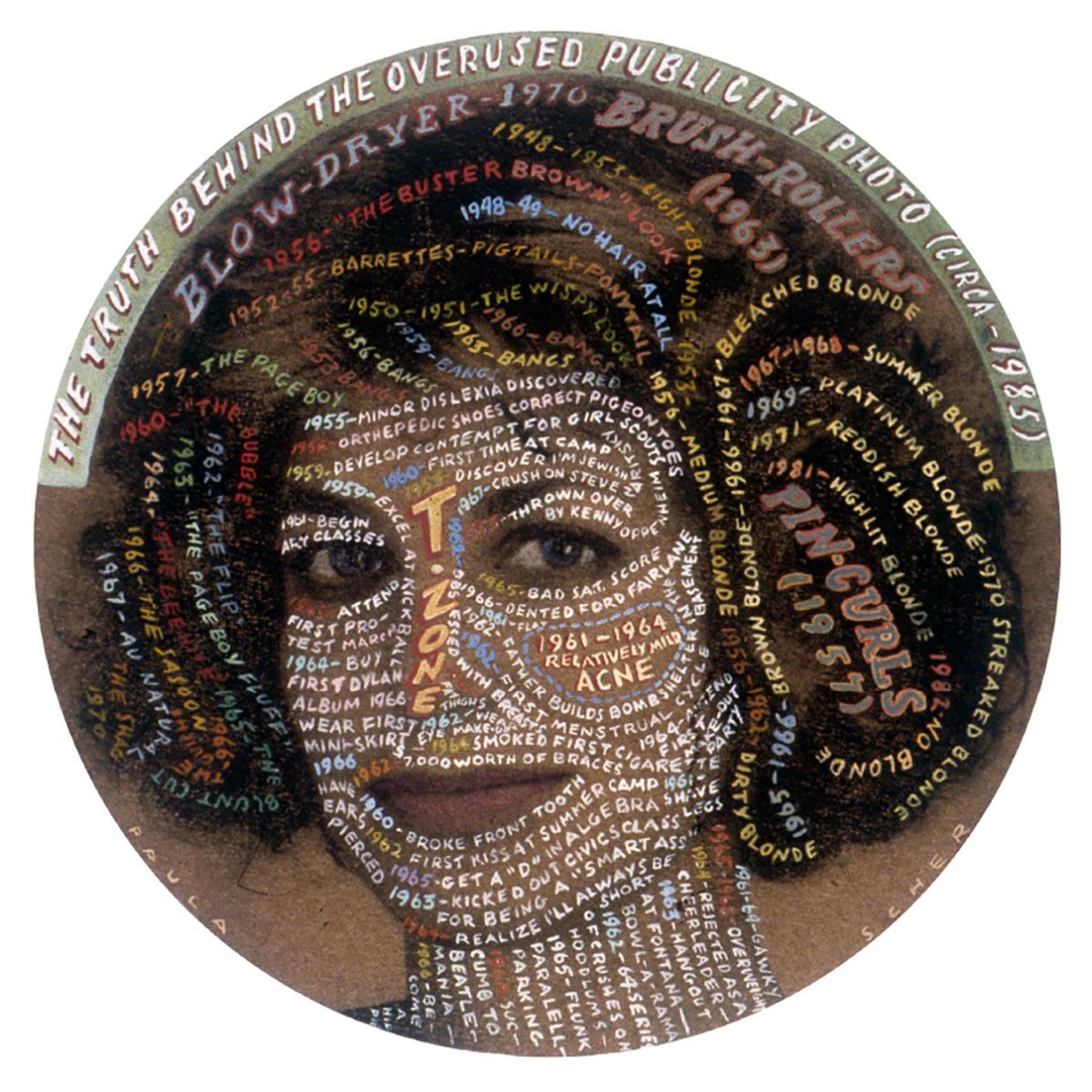
Self-portrait of Paula Scher created for the AIGA, 1992 [3]

In this work Paula combines her love of typography, a traditionally design based skill, and transfers or elevates it into the world of art by using it as a visual link between an image and a memory. This personal injection into the work is part of why it would be viewed as art rather than design, however using the same skills, ideas of colour theory and composition, Paula creates works that are more closely viewed as design outcomes.

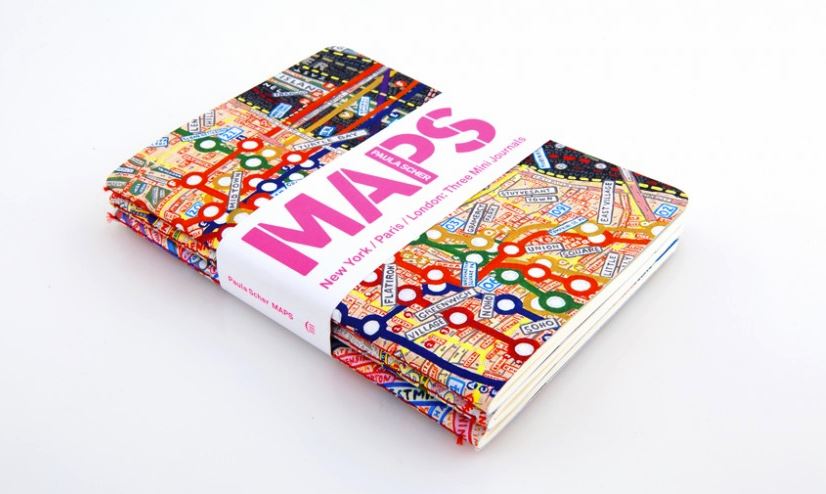
Pocket books featuring Paula Scher’s Maps [4]

Paula has a create love for organising information, and that can be seen in her map illustrations. They are both beautiful and also serve the purpose of a map, if slightly hard to read. However, to me these seem as close a meeting of the worlds of design and art as can be as they are both completely self indulgent at the same time as being entirely useful for a purpose.

When compared to my own work, it can be seen that my pieces are still more rooted in either art or design, whilst Paula’s demonstrate a closer meeting in the centre, without necessarily succumbing to the participatory design described by Matthew Holt in his article.

[1] Matthew Holt, ‘Transformation of the Aesthetic: Art as Participatory Design’, 2015

[2] Paula Scher, Abstract, The Art of Design: S1 E6, Netflix

[3] Image accessed on 06/04/2019 from https://www.pinterest.com.au/pin/655344183253220064/

[4] Image accessed on 06/04/2019 from
https://www.designindaba.com/articles/creative-work/pocket-map

Callum Douglas – 28830644 – topic 2: Contextualise your own design practice

Forgotten female graphic designer —— Margaret Calvert

When you walk pass the streets, have you ever wondered who were the people contributed those easy-read, recognizable street signs? Why is it making such importance to us when we driving on the roads? It is naturally easy to neglect the things that we growing up with, the things that we see every day, much less it was a female designer —— Margaret Calvert.

Not as identical as male designer throughout the design history, female designers seem have been blended out of the industry. Calvert was a graphic designer, typographer born in South Africa, 1936, moved to UK in 1950, where she met her tutor, Jock Kinneir who hired her as his assistant to design the signs for Gatwick Airport. That was the time of black and yellow colour scheme was born [1]. Since then Calvert and Kinneir started working together, later becoming business partners [2]. As typographers, Calvert and Kinneir worked together and developed typefaces such as New Transport which were broadly used by countrywide in UK. Later on in 1957, Kinneir was named to redesign roadside sign system by the UK government and Calvert came up with simple, straight forward pictograms based on former road sign design. Resulting in a significant change to road safety while inspiring the majority of countries worldwide. However, although she has made such great contribution, she has never received broad appreciation by the public until 21st century.

road sign on the way to the airport (UK)
Black and yellow colour scheme in Gatwick airport (UK)

If we take a look at the statistics of the ratio of female designers were working as professionals in last century, there is a scarcity of women being involved from all aspect of design industry. Why have female designers been forgotten by the industry from the last century? Margaret Bruce and Jenny Lewis raised their opinion in the article Women designer —— is there a gender gap? that, sexual stereotyping made a significant impact [3]. It attributes that people were having strong opinions of under some certain circumstance one gender performs a better outcome than another, which were typically thought women were better at doing domestic family and men does better job in relation to facing the ‘public’ [4]. Due to the historical reasons, women designers have always been helping develop specific ‘way of seeing’ [5] but have not always had proper institution education history.

As Bruce and Lewis concluded, there are ‘three-hurdles’ [6] for woman designers have a role in the industry. First ‘hurdle’ is to be qualified study in an institution, second is to get a job, the third belong to success at work [7]. Due to the historical patriarchal mind side, during and after second would war women were mainly considered as ‘worker’ who carried out the orders by the males. Therefore, it had always been the male being the ‘judges’ of professionalization depicts that woman have never gotten a chance to showcase their ability.

Here, time has come to 2019. From my own experience of being a communication design student, the situation indeed has dramatically shifted. While the time I have been my studies at Monash University, more than half of my classmates or my tutors are female, we are just laying the same attention to the designers who are capable of contributing no matter what gender she/he is. Certainly, discrimination still existing in social presents. Working on erase out discriminated mindset is an obstacle we human beings have to overcome on the way going towards more advanced civilisation.

[1][2] Design Inbaba, https://www.designindaba.com/profiles/margaret-calvert.

[3][4][5][6][7] Margaret Bruce and Jenny Lewis,Women designer —— is there a gender gap?