Welcome to Wasteland, Besser Space Collingwood.
The ideas of a Wasteland have been derived from the Latin meaning of waste which is uncultivated/unoccupied[1]. The bases of the manifesto for the exhibition ‘Welcome to Wasteland’ is an explanation of these original meanings. With focus upon land and waste the exhibition holds products and art created from products of waste. Industrial designers, graphic designers and architects were asked to create a product out of waste for the exhibition. All together 32 designers across various disciplines participated and contributed to the final exhibit. Hosted in Besser Space in Collingwood the works were displayed as part of Melbourne Design Week provoking thought into our production of waste and the transformation of it.
Exploration of the use of waste materials exhibited is vast ranging from pigs blood to coffee grounds, to materials such as wood and marble. Insight was provided as to how leading practitioners are approaching the Australian waste issue. The question arises as to the responsibility of designers when regarding issues of waste and sustainability. The manifesto for Wasteland states that ‘the act of making wasteful products is negligence’[2]. The statement is direct and clear calling on designers to be able to sustain their field. By not designing sustainably does the result still classify itself as good design? Is it okay to not consider the implications of designs produced or is that as stated negligence? By making ethical design practices known to industry we may then explore the results of good design at the heart of production.
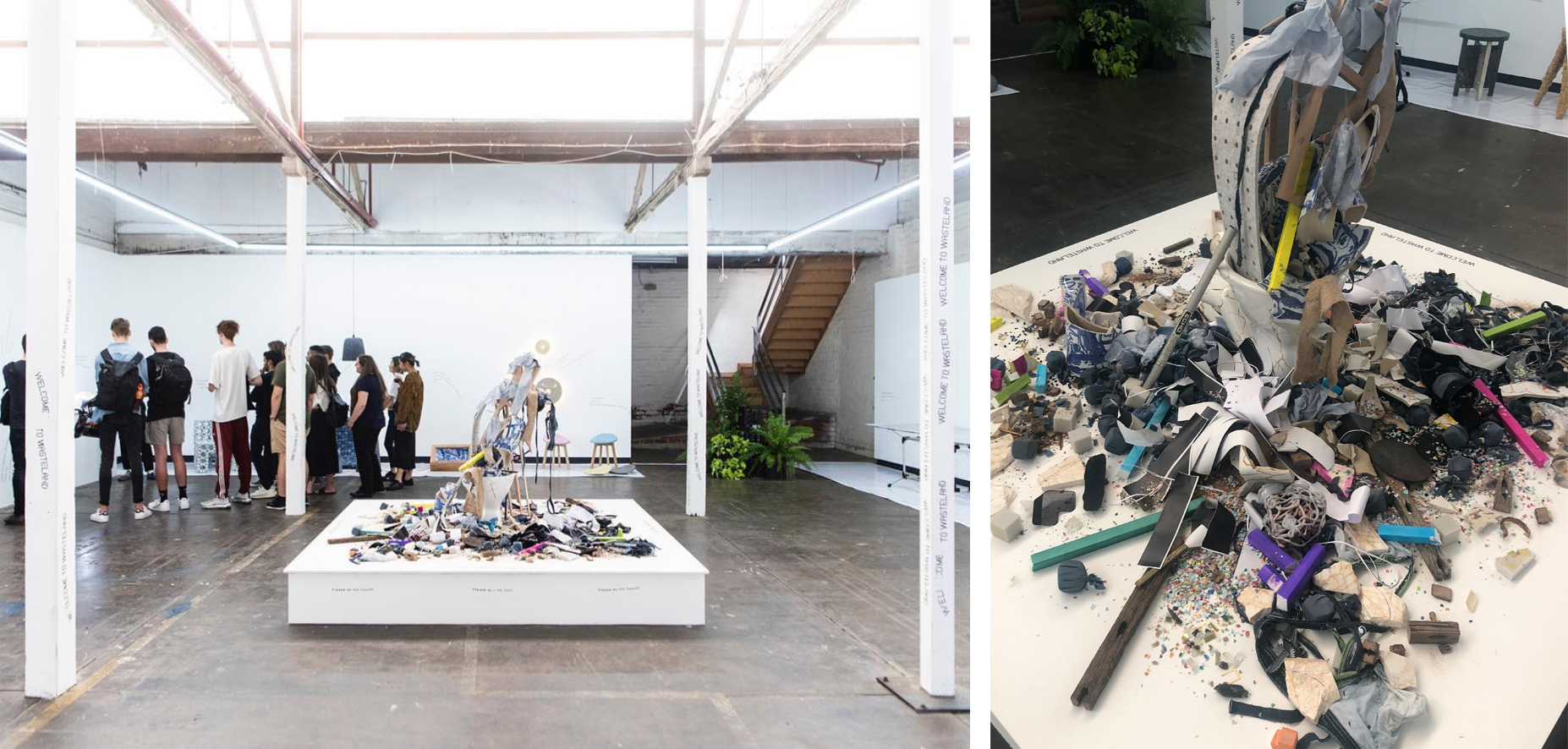
In the centre of the exhibition, on a pedestal, stood the collection of waste produced from the designers during production of the objects for the exhibition. This centre piece statement reiterates that waste is at the heart of the exhibition[3]. The placement of the waste is seen growing up from the toilet in the centre and also spreading around the base. The choice of displaying the waste objects in this manner instead of an organised one also demonstrates the carelessness for discarded waste. Materials of all sorts were included and only sharp knifes or tools were omitted for safety purposes. The collection in the centre also speaks as to the amount of waste that is produced. It provokes thinking as to what the centre would look like for waste beyond the production of only 32 objects.
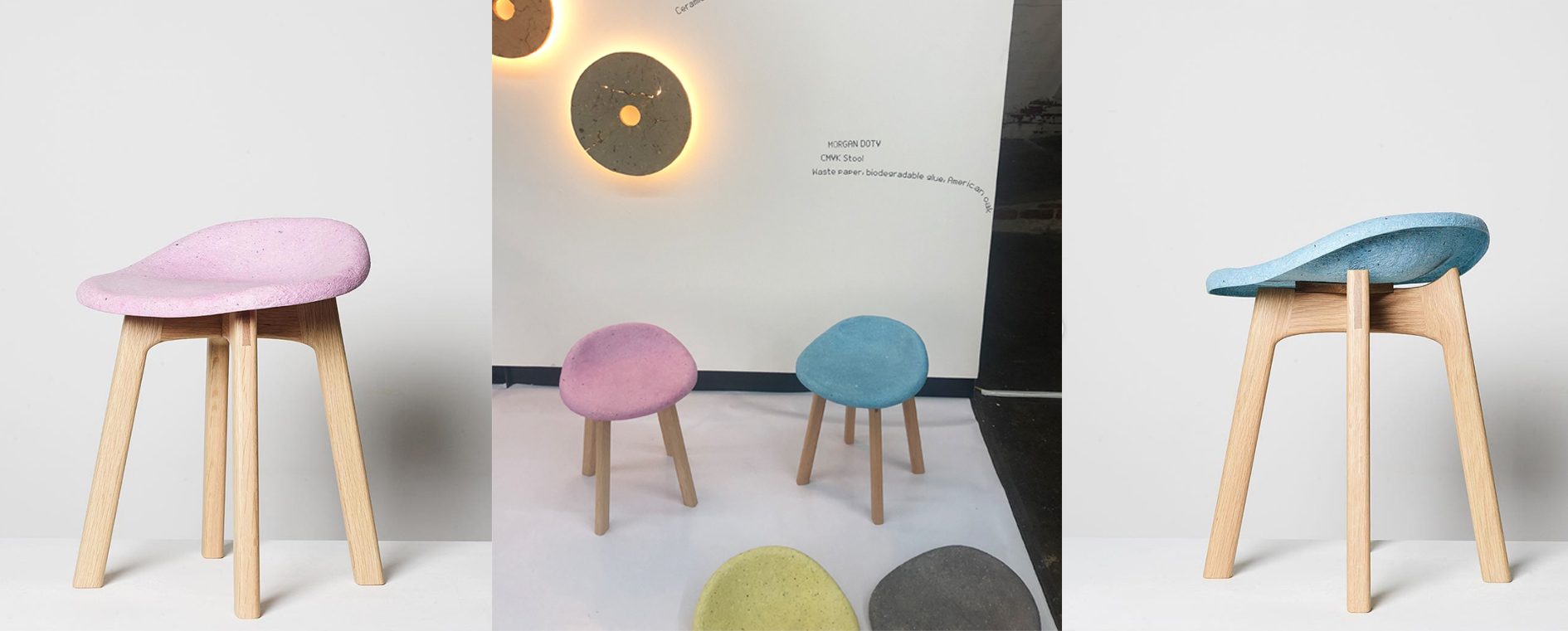
Designer Morgan Doty contributed to the exhibition with her CMYK Stools. The 4 stools were created out of waste paper, biodegradable glue and American oak. The stools explore the concept of paper being given a more permanent use as furniture. The use of paper is short lived as someone may write something down then throw the page away instantly. This contrasts to the form of furniture which is an object that is used repeatedly over a longer life span. The shredded paper pulp was moulded and combined with digital fabrication techniques to achieve the shell structure of the top of the furniture stool. The stools act as a physical manifestation of printing with each stool representing the ink based colours CMYK (cyan, magenta, yellow and key). The materiality of the stool is stated with the textured surface displaying fragments of text from the waste paper. The rawness of materials impacts the design and makes each stool unique even though they are all uniform. Designing with a message and purpose is seen in this work with a sustainable re use of waste material. Morgan states that ‘each tonne of paper recycled saves 13 trees, 331,780 litres of water, 2.9 tonnes of CO2 emissions and 4 cubic meters of landfill’[4]. This large impact communicated places the stools in perspective and re affirms the impact of recycling.
Critiquing whether the design presented is classified as good design comes from the intention of the designer. Good design is seen to be acknowledged by colleagues as being creative, imaginative, skilful and having a certain depth in thought and intention[5]. Even as the materials used are classified as waste, the re-production with purpose and meaning brings the waste into a new life. Good design and good taste are often used interchangeably although the concepts of each vary. The thought and intention of the recycled waste as products may be seen as good design but does that result in it being tasteful design. Is a pile of waste in an exhibition considered design and of good taste? In analysing what is considered good taste it is found that taste is socially constructed. Therefore, it speaks of the systems and processes people create as the criteria for determining what is considered as good taste[6]. As a society the wastefulness and negative impacts of mass consumption are on a grand scale. By coming to terms with wastefulness and by not neglecting our impact this could socially construct a new criterion of what is considered to be of good taste.
The exhibition Wasteland in
my opinion is of good taste and design as it generates meaning for users and
viewers of the works. The intentions of each of the 32 designers work towards
the overarching concept to not be negligent when it comes to waste. Products
produced provided opportunities for the discarded functional objects to exist
beyond their intended destination of disposal and landfill. Not only were the
creation of these objects sustainable but the production and display of the
exhibition also adopted sustainable processes. Examples of this include the solar
powered web server which runs the website for the exhibit. Another example is
seen as the text on the exhibit walls were done using a hand-held gun as an
alternative to printing on large rolls of paper. All elements of the exhibition
create a sense of awareness and call on designers to take an un wasteful
approach.
[1] Friends and Associates, “Welcome to Wasteland,” Wasteland, accessed April 7 2019, http://solar.friendsand.associates/
[2] Ibid
[3] Friends and Associates, “friends.associates,”, accessed April 7 2019, https://www.instagram.com/friends.associates/
[4]Friends and Associates, “Morgan Doty CMYK Stool,” Wasteland, accessed April 7 2019, http://solar.friendsand.associates/waste-paper-biodegradable-glue-american-oak
[5] Despina Christoforidou, Elin Olander and Anders Warell, “Good Taste vs. Good Design: A Tug of War in the Light of Bling,” The Design Journal 15, no. 2 (2012): 187-191.
[6] Ibid











 Design Ideas