Welcome to Wasteland, Besser Space Collingwood.
The ideas of a Wasteland have been derived from the Latin meaning of waste which is uncultivated/unoccupied[1]. The bases of the manifesto for the exhibition ‘Welcome to Wasteland’ is an explanation of these original meanings. With focus upon land and waste the exhibition holds products and art created from products of waste. Industrial designers, graphic designers and architects were asked to create a product out of waste for the exhibition. All together 32 designers across various disciplines participated and contributed to the final exhibit. Hosted in Besser Space in Collingwood the works were displayed as part of Melbourne Design Week provoking thought into our production of waste and the transformation of it.
Exploration of the use of waste materials exhibited is vast ranging from pigs blood to coffee grounds, to materials such as wood and marble. Insight was provided as to how leading practitioners are approaching the Australian waste issue. The question arises as to the responsibility of designers when regarding issues of waste and sustainability. The manifesto for Wasteland states that ‘the act of making wasteful products is negligence’[2]. The statement is direct and clear calling on designers to be able to sustain their field. By not designing sustainably does the result still classify itself as good design? Is it okay to not consider the implications of designs produced or is that as stated negligence? By making ethical design practices known to industry we may then explore the results of good design at the heart of production.
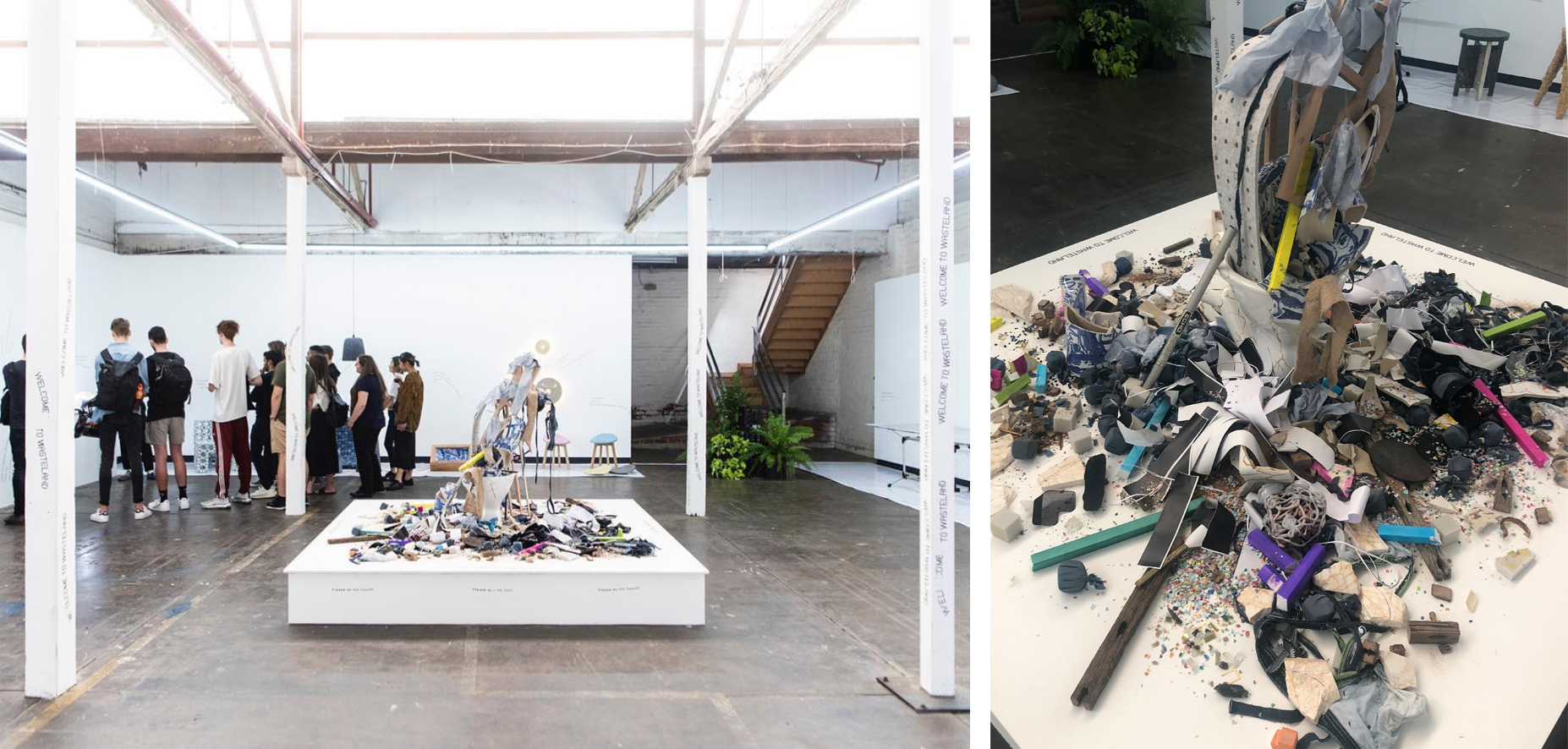
In the centre of the exhibition, on a pedestal, stood the collection of waste produced from the designers during production of the objects for the exhibition. This centre piece statement reiterates that waste is at the heart of the exhibition[3]. The placement of the waste is seen growing up from the toilet in the centre and also spreading around the base. The choice of displaying the waste objects in this manner instead of an organised one also demonstrates the carelessness for discarded waste. Materials of all sorts were included and only sharp knifes or tools were omitted for safety purposes. The collection in the centre also speaks as to the amount of waste that is produced. It provokes thinking as to what the centre would look like for waste beyond the production of only 32 objects.
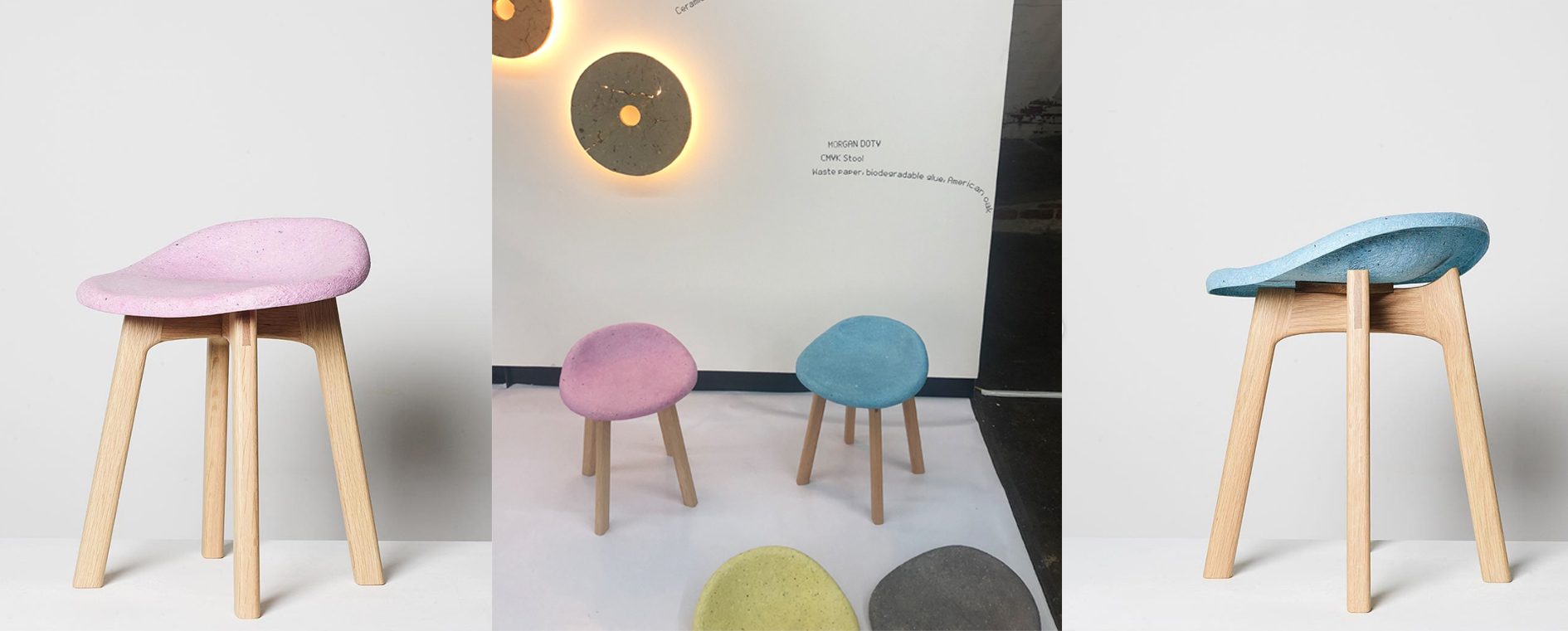
Designer Morgan Doty contributed to the exhibition with her CMYK Stools. The 4 stools were created out of waste paper, biodegradable glue and American oak. The stools explore the concept of paper being given a more permanent use as furniture. The use of paper is short lived as someone may write something down then throw the page away instantly. This contrasts to the form of furniture which is an object that is used repeatedly over a longer life span. The shredded paper pulp was moulded and combined with digital fabrication techniques to achieve the shell structure of the top of the furniture stool. The stools act as a physical manifestation of printing with each stool representing the ink based colours CMYK (cyan, magenta, yellow and key). The materiality of the stool is stated with the textured surface displaying fragments of text from the waste paper. The rawness of materials impacts the design and makes each stool unique even though they are all uniform. Designing with a message and purpose is seen in this work with a sustainable re use of waste material. Morgan states that ‘each tonne of paper recycled saves 13 trees, 331,780 litres of water, 2.9 tonnes of CO2 emissions and 4 cubic meters of landfill’[4]. This large impact communicated places the stools in perspective and re affirms the impact of recycling.
Critiquing whether the design presented is classified as good design comes from the intention of the designer. Good design is seen to be acknowledged by colleagues as being creative, imaginative, skilful and having a certain depth in thought and intention[5]. Even as the materials used are classified as waste, the re-production with purpose and meaning brings the waste into a new life. Good design and good taste are often used interchangeably although the concepts of each vary. The thought and intention of the recycled waste as products may be seen as good design but does that result in it being tasteful design. Is a pile of waste in an exhibition considered design and of good taste? In analysing what is considered good taste it is found that taste is socially constructed. Therefore, it speaks of the systems and processes people create as the criteria for determining what is considered as good taste[6]. As a society the wastefulness and negative impacts of mass consumption are on a grand scale. By coming to terms with wastefulness and by not neglecting our impact this could socially construct a new criterion of what is considered to be of good taste.
The exhibition Wasteland in
my opinion is of good taste and design as it generates meaning for users and
viewers of the works. The intentions of each of the 32 designers work towards
the overarching concept to not be negligent when it comes to waste. Products
produced provided opportunities for the discarded functional objects to exist
beyond their intended destination of disposal and landfill. Not only were the
creation of these objects sustainable but the production and display of the
exhibition also adopted sustainable processes. Examples of this include the solar
powered web server which runs the website for the exhibit. Another example is
seen as the text on the exhibit walls were done using a hand-held gun as an
alternative to printing on large rolls of paper. All elements of the exhibition
create a sense of awareness and call on designers to take an un wasteful
approach.
[1] Friends and Associates, “Welcome to Wasteland,” Wasteland, accessed April 7 2019, http://solar.friendsand.associates/
[2] Ibid
[3] Friends and Associates, “friends.associates,”, accessed April 7 2019, https://www.instagram.com/friends.associates/
[4]Friends and Associates, “Morgan Doty CMYK Stool,” Wasteland, accessed April 7 2019, http://solar.friendsand.associates/waste-paper-biodegradable-glue-american-oak
[5] Despina Christoforidou, Elin Olander and Anders Warell, “Good Taste vs. Good Design: A Tug of War in the Light of Bling,” The Design Journal 15, no. 2 (2012): 187-191.
[6] Ibid

 Design Ideas
To consider how to recycle and reuse our discards is a significant topic in contemporary society as the fast developing society. To evoke people’s mindset of dealing with waste is one of the responsibilities of a designer. Good design is not only seen as creative or aesthetic appearance, but also the thought of the designer that try to deliver to the audience. And this is another aspect to creating a good design. A successful design is able to be seen have good taste and good design as well. Good taste basically constructed by society and it speaks of the systems and processes people create as the criteria for determining what is considered as good taste. However, good design and good taste usually are seen as two isolated identities in modern society that caused by plenty of designers think this may impossible to keep them exist in one design. However, this exhibition is one of the succeeding examples that show it is not an aim hard to achieve. In this exhibition, considering making people pay attention to the contemporary Australian waste and the way to manage these wastes is a good topic to combine with design, the atmosphere in the exhibition shows an environmental consciousness that is a sort of good taste. There is another important way that shows this exhibition have good taste is it beneficial to society as the critical thinking of contemporary society. In the design aspect, good design and good taste could both exist in one design, in this exhibition, especially the two designs that this essay pointed out, both demonstrate aesthete and taste, the designers use their unique approaches to convey a sustainable design mindset to audiences. The essay also points out that the exhibition quite focuses on details, for instance, the exhibit walls were done by a hand-held gun instead of printing on a large roll of paper which most modern exhibition will do.
LikeLike
Waste management in design is crucial in building a sustainable future in which design objects do not negatively impact the planet after their intended use has been expended, as well as a reduction of byproducts used to create the items initially. Whilst there is an emphasis on reducing the impact of existing waste, its also important to explore new ways of creating using renewable materials, such as bamboo.
Bamboo is an extremely fast growing, easy to cultivate and strong building material. Companies such as Ibuku and designers like Samy Rio are finding new ways to take advantage of this plentiful natural resource.
Ibuku is a company in Indonesia that is using Asia’s abundant supply of Bamboo to create housing that is entirely made from bamboo, treated to resist the toll of time and strong as industrial grade steel. These houses produce very little waste when compared to traditional house building methods, and after the home is no longer able to be lived in, which could take as many as 100 years, the materials can be either re-used or put back in the ground to decompose.
Samy Rio creates smaller scale design objects that would replace traditionally plastic or metal alternatives with sleek minimalist bamboo designs. These objects perform the same function just as well as the originals, and in my opinion look much nicer, so from my stand point they would be considered good design.
Bamboo is just one example of how we can tackle some of the issues regarding waste that were brought up in your essay.
http://www.samyrio.fr/
http://ibuku.com
LikeLike
Given our rapid depletion of resources, especially raw materials, and Australia’s ever-increasing waste creation, it’s time we change. We need to ask ourselves, what are the best ways to encourage resource recovery and recycling to get to “zero waste”? I believe the focus needs to be on avoiding waste production in the first place. We have to change the way we design and construct products to make it easier to reuse them once they have already been consumed.
Since these deliberations, there have been many designers that have explored and presented numerous solutions towards the ‘zero waste’ initiative. Sustainable design could be one way in achieving ‘zero waste’ through reducing our impact on the environment. With sustainability at the forefront of design, there has been an increase in environmental products and packaging from keep cups to green bags. This would be considered good design, according to the post, as these products are “creative, imaginative, skilful and [has] a certain depth in thought and intention.” Also, these products are similar to the artworks presented in the Welcome to Wasteland exhibition. Not only were the creation of these objects sustainable but the production and display of the exhibition also embraced various sustainable processes. It is clear that the exhibition creates a sense of awareness and calls on society to reimagine how we perceive waste.
Imagination is essential to these ideas. If we want to think our way out of these problems, it’s important to be able to imagine things differently. Hopefully society can explore the use of waste materials, take these challenges into consideration and change for the better.
LikeLiked by 1 person
It is a shame that waste is so prevalent and unthought about, only until the past 5 years, people have made a more conscious effort to reduce their waste. Our society does not recognise their impact on the Earth, and it’s easy to think “I’m just one person, I won’t be that huge of an impact” however it has been estimated that the average Australian produces about 1.5 tonnes a year- a huge amount considering that it also takes 1000 years to decompose plastic.
This exhibition raises many issues about the cycle of waste, we constantly leave our waste for the garbage truck to pick up and obliviously leave it for them to deal with. I feel irritated that land fill has been an issue since the 1940’s and the only waste reducing behaviours that we have come up with are by using metal straws and green bags- though it is a step up, it only makes the slightest difference to the scale of this issue.
‘The act of making wasteful products is negligence’ forces me to think about everything that we consume, even though we are being sustainable, I believe it will be subject to the person consuming it. Yes, in essence it is a product made we thought and recycled materials, however what will its future look like? If it decomposes then I rest my case. We need to treat sustainable objects with a sustainable attitude, believing that products don’t have a shelf life of less than 3 months. By consuming less and treating our belongings with care and diligence, we can expect a world with less waste.
I agree with your statement that “as the materials used are classified as waste, the re-production with purpose and meaning brings the waste into a new life.” This aligns with the same concept as the Keepcup, most of which are recycled from waste and re-used for coffee, though they are purchased for a better cause, we need to recognise that it requires more energy to produce than it does for paper cups. You need to use the Keepcup at least 30 times for it to be equivalent to the manufacture of the 15 paper cups you will consume with.This gives the reusable coffee cup a new meaning and lease of life when utilised efficiently. Though the company has good intentions and have a good vision, it raises my concern around the vicious cycle of waste. Where will that Keepcup be when you no longer want to use it? Will it decompose or end up in landfill? This example is not applicable to your exhibition because they aim to raise awareness about waste whereas Keepcup is active and current in the market.
I think people are taking slow and steady steps to be more environmentally friendly, by ridding plastic straws and using green bags. However it baffles me that we continue to buy packaged foods. It’s like being vegan, we can make the right choices if we want to and if it really mattered, but it’s just easier to have meat because it’s accessible.
I think, for the sake of the earth, we need to eliminate the factor of good design in the superficial/aesthetic sense and define good design as something that is not detrimental to our earth. We can restructure the materials we already have and give meaning to that, incorporating our ethical decision may not deliver the exact result but it is good to know that there has been consideration and thought processes to produce that design in a less toxic manner. Designers play a major role in sustainability because of our ability to attract consumers into buying more, it is our role to be resourceful and think about the implications of our messages.
LikeLike