Women have been constantly ignored in the workplace
throughout history, and in the design industry it is no different. More than
50% of GD graduates are comprised by women, a rate which is steadily increasing
however since the 1970s only one Woman was included in the AGDA Hall Of Fame. (Bruce
& Lewis) The AGDA’s own committee board is comprised of mostly males, and
the same goes for many design firms.
The Designing Women exhibition highlights the work of ongoing female designers,
celebrating their creations but also to give them a voice as they are often
overlooked in the male dominated industry. The exhibition is not limited to one
field of design but unites all female designers from all the different fields
in order to inspire both current and future designers whilst respecting the
contributions from female designers of the past.
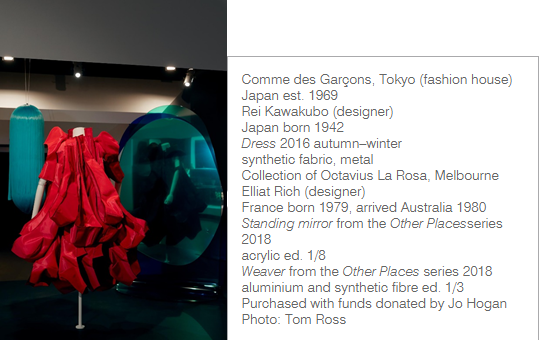
This arrangement of artworks has a powerful image representation of the design industry, it represents the different challenges and experiences that women have faced whilst trying to succeed. The dress which is reflected in the mirror can be said to describe how the design industry is male dominated, even if the work a female artist produces is amazing the artist is overshadowed just because she is a female. This is reflective of the statistic that was presented earlier, how even though women are clearly present in the industry by making up more than 50% of the GD graduates hardly any of them gain any recognition.
The colour red of the dress represents the strength, determination and passion that female designers have for their art and are willing to persevere against the odds in order to have their work recognised and respected. This representation describes the experiences of Lynda Warner, who was placed in a time period where there were hardly any female designers as the industry was seen as one that were driven by males only and females were made to do dress making or secretary jobs. However, Lynda was determined to pursue her area of passion and with the support of her parents she completed her commercial art qualification at Swinburne university. She was then handpicked by a professional designer as her portfolio was so good, where she progressed to start her own career after his tutorage where she continued to succeed.
(Connory, 2017)
Another interpretation of this is that the dress is the female’s artist career at her prime however, after entering parenthood it becomes muddied and uncertain as shown by the dull colours of the dress reflected in the mirror. This represents the social issues surrounding work and motherhood, as women tend to be looked over for promotions, paid less and assumed to be un-competent at her job just because she became a mother. This social issue is present in all areas of work, and it is no different here as from the experience of Michaela Webb, she found that she was discriminated against after trying to return to her career after having a child. In order to maintain her career, she had to shift the way she thought about work from the role of an active worker she became a more managerial one. These are only some of the social issues which continue to impact the women in the Industry and discourages them from seeking a career as a designer.
(Connory, 2017)
There is also the social stigma that women should only do “feminine” work such as fashion and textiles, while men do the more practical work such as industrial design. (Connory, 2017) This combined with the other social issues creates several hurdles women designers have to overcome in order to be successful designers. These issues are represented by the many layers on the dress, as each layer presents each hurdle and as these hurdles build up over a woman’s career it forms several layers that the female designer has to cope with to maintain her career. For example, the first hurdle would be getting into the university for a design course which isn’t considered feminine, the second would be getting a job as a female designer and a third would be trying to fit motherhood into her career. (Bruce & Lewis)
The Designing Women exhibition cleverly depicts the problems and issues in the Design Industry of today by using female designer’s works which at the same time gives them exposure in order to help fix those issues. It highlights the many difficulties that women have to face in order to establish her own career as a designer, as well as to maintain it. These difficulties include the social issues and discrimination that arises due to motherhood, or simply being a woman. If we want to end these issues we must raise awareness about them, which is what the Designing Women exhibitions is trying to achieve.
References
Bruce, M., & Lewis, J. Women Designers- Is There A Gender Trap? Retrieved from: https://lms.monash.edu/pluginfile.php/8323633/mod_resource/content/1/wk%209%20bruce%20and%20lewis%20women%20designers%202.pdf
Connory, J. (2017). Plotting the Historical Pipeline of Women in Graphic Design. Retrieved from: https://lms.monash.edu/pluginfile.php/8323632/mod_resource/content/1/Wk%209%20Plotting-the-Historical-Pipeline-of-Women-in-Graphic-Design_171117.pdf

 Design Ideas
The industrial design is not really equal for men and women and is often referred to as a man’s world. Designing requires a highly rational and sensible thinking, fresh creativity, and ample physical strength to support a long-time, highly focused work. People’s inherent understanding of gender differences will naturally lead to the conclusion that “this job is more suitable for men”. However, people forget that many times women are tougher than men, and their minds are more delicate. Nowadays more and more female designers are beginning to emerge and even stand on the top of industrial design. They voiced women and used their own power to change the direction of the design style.
“Every successful man has a woman behind him.” This sentence should really be used to describe Lilly Reich. Her husband is Mies van der Rohe, one of the most widely mentioned modern design pioneers in our mouth. They are working partners and lovers for more than 10 years. Take the example of the classics of Mies, the Barcelona seat that symbolizes modernist furniture. It was actually designed with Lilly and is now often classified as a personal work by Mies. Also, Anna Castelli Ferrieri is known as the wife of Giulio Castelli, the founder of Kartell, the Italian national treasure furniture brand, but it is because of Anna’s design that Kartell gradually opened its popularity. Anna used materials such as plastics that were not practical at the time, bringing such as Componibili storage cabinets to be flexible and functionally displayed in a stacking module, making it the best-selling furniture item for Kartell today. In addition, she is an important founder of the Italian Industrial Design Association. Most female architects are aware of the fact that Mies van der Rohe entered the temple of modernist architecture, and that the architect’s lover, Lily Rick, had nothing when he passed away; Robert Venturi won in 1991. The Leezer Architecture Award, wife and partner Dennis Scott Brown, has never been recognized.
Industry design women should also have the same status as men. There should not have any gender gap.
LikeLike