In the Journal article, Transformation of the Aesthetic: Art as Participatory Design, by Matthew Holt, Holt asserts that there has been a long standing connection between art and design, and that it is a bridge so short that many artists jump from one side to the other with little effort. There have also been writers such as Alex Coles that have discussed this closeness in detail. Coles coined the term ‘designart’ to describe this grey area between the two fields.[1]
While most of Holt’s article focuses on participatory projects acting as a bridge between art and design, I would argue that this is not the only necessary bridge. Certainly from a design perspective travelling in the direction of an art perspective, collaborative design is a huge step towards the art side of things.
However what about approaching this idea from an artists perspective, where a piece is not necessarily created with an audience in mind at all, unlike design, it has the luxury of being almost entirely introspective if the artist so chooses. I have often indulged in selfishly ignoring what a customer may or may not purchase or relate to, in order to express my own ideas, something that if applied to design, would result in a failed creation.
But on the other side, as I have learned design, I have also learned to create a distance between myself and my work where the audience sits, and where they too have a say. This mixture of selfish and selfless creation can be jarring, but is there a middle ground between the two, aside from participatory design? Something both personal and accessible to an audience?
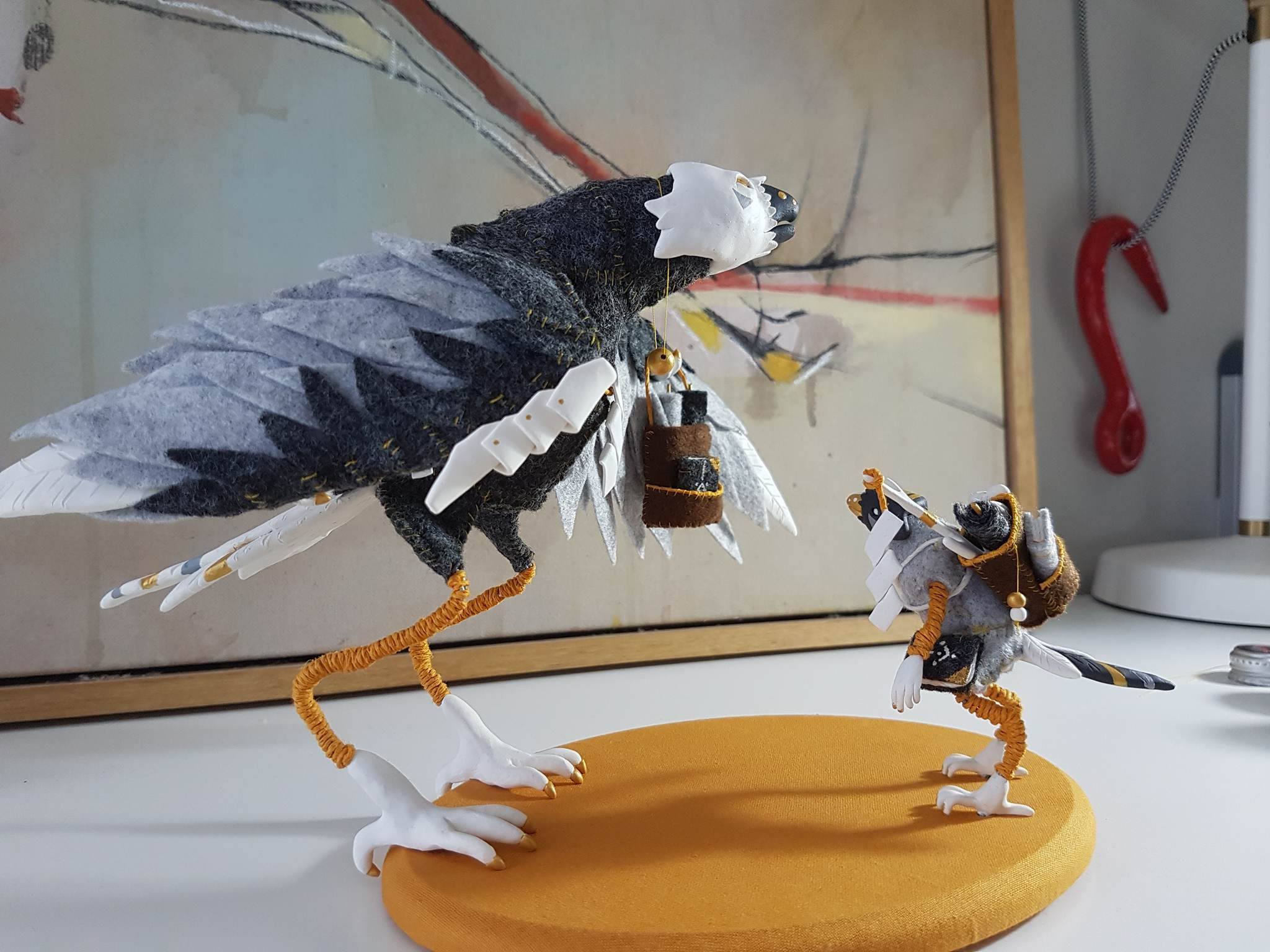
This is a sculptural work I created in 2017 called ‘The Dusk-trader’ which at the time, I would have considered a completely self indulgent piece. However upon closer thought, years later, and with a bit of design understanding, I can see that several aspects of the work could be seen as edging toward design.
Something both art and design can’t escape sharing is use of colour to create emotional responses to work. I have always stuck to a limited palette, with equal distribution across all elements. And even when creating a piece of design work, unless specified by a brief, the use of colour is always something I do for myself. Unless absolutely necessary I wont budge on my colour choices.
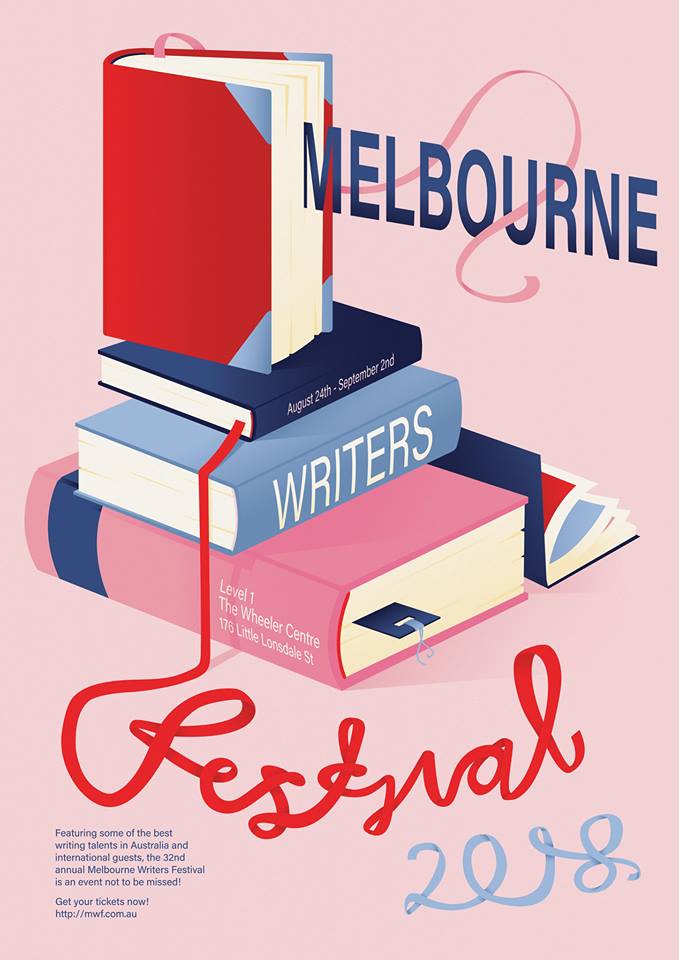
The similarities in colour distribution can be seen in this work created last year to promote the Melbourne Writers Festival. The colour, in both works, is what is used to lead the eye around the piece. The choice of colours in both circumstances were based on design ideas, in that all of the colours chosen harmonise together, and the limited palette allows for easier distribution. The colours however, are not representative of anything in particular, but where selected based simply on my feelings at the time. This is both selfish and selfless at the same time and perhaps a small way in which design and art can come together in pieces.
An artist/designer that shows how the two disciplines can be hard to separate at all is Paula Scher. She claims that ‘Typography is painting with words, that’s my biggest high.'[2] This statement shows a personal emotional reward related to the practice of design, which would otherwise usually be associated with art. Paula has been shifting between the worlds of art and design for many years, and some of her work is hard to describe as either in particular.
‘I could never walk into an office, and sit down at my desk to design’ Paula explains her method involves a move introspective experience when creating a design to solve a problem, which also reflects ways in which both and artist and designer would tackle the creative process, both selfish and selfless at the same time. It is both involving herself, and using that to solve a problem for someone else.
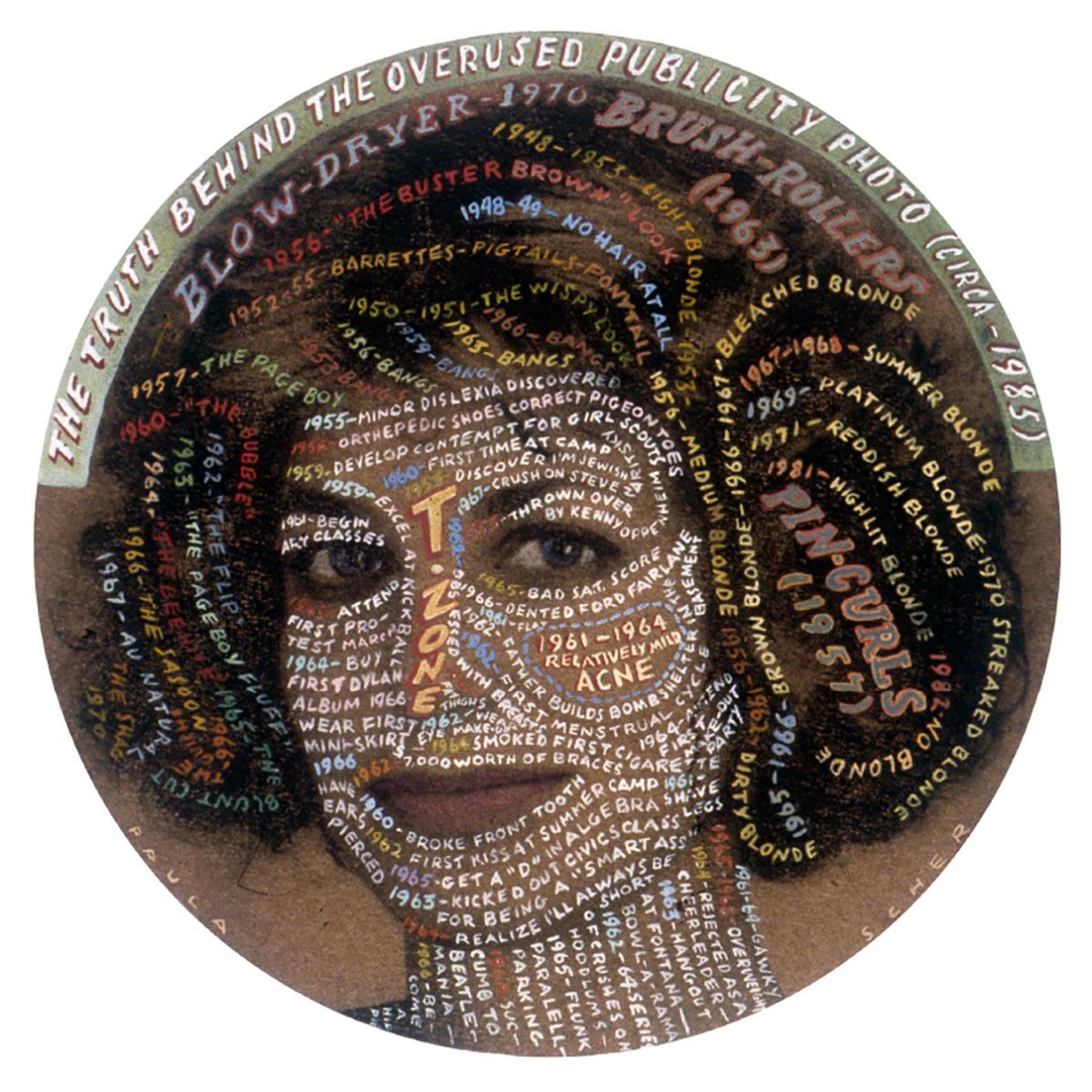
Self-portrait of Paula Scher created for the AIGA, 1992 [3]
In this work Paula combines her love of typography, a traditionally design based skill, and transfers or elevates it into the world of art by using it as a visual link between an image and a memory. This personal injection into the work is part of why it would be viewed as art rather than design, however using the same skills, ideas of colour theory and composition, Paula creates works that are more closely viewed as design outcomes.
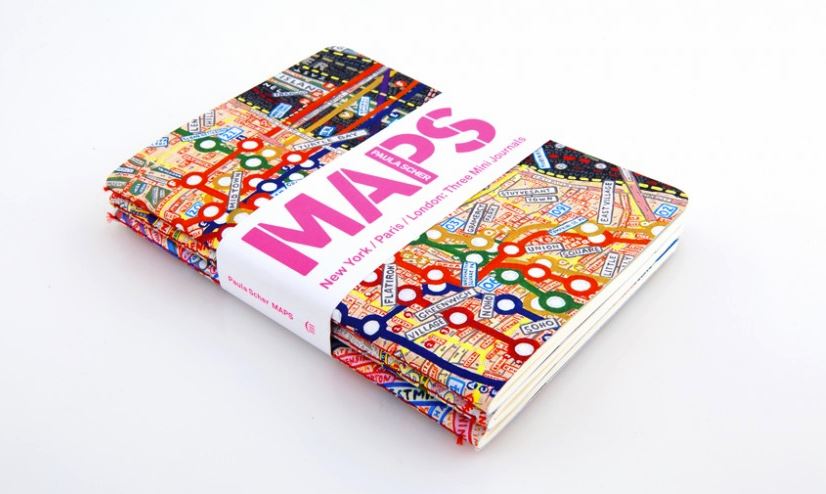
Paula has a create love for organising information, and that can be seen in her map illustrations. They are both beautiful and also serve the purpose of a map, if slightly hard to read. However, to me these seem as close a meeting of the worlds of design and art as can be as they are both completely self indulgent at the same time as being entirely useful for a purpose.
When compared to my own work, it can be seen that my pieces are still more rooted in either art or design, whilst Paula’s demonstrate a closer meeting in the centre, without necessarily succumbing to the participatory design described by Matthew Holt in his article.
[1] Matthew Holt, ‘Transformation of the Aesthetic: Art as Participatory Design’, 2015
[2] Paula Scher, Abstract, The Art of Design: S1 E6, Netflix
[3] Image accessed on 06/04/2019 from https://www.pinterest.com.au/pin/655344183253220064/
[4] Image accessed on 06/04/2019 from
https://www.designindaba.com/articles/creative-work/pocket-map
Callum Douglas – 28830644 – topic 2: Contextualise your own design practice

 Design Ideas
Design is art, but art is not design. As you explore in your analysis, they are one but the same yet entirely different. The distinction between these convoluted, similar yet dissimilar areas has been debated for some time. Both of these facets of art boil down to creating visual compositions and vectors to deliver the creators knowledge. Yet the major area where art and design differ is their reasons for being.
First of all, I would like to detail my understanding of the two entities of art and design. In majority of scenarios, Art is something that is much more personal than design. It’s a process that begins with an empty object; such as a blank canvas or a slab of clay. The artwork is then created by the sentiments and/or feelings that the artists holds, and this translates into the work. Majority of the most famous artworks in history encapsulate their audience by creating a sentimental bond into the piece, as it is a window into the intricacies and personal traits of the creator. Art starts from nothing, it is the artist who imbues their work into a piece that creates something, and this is where design differs. Designers always have a commencement stage in some way, shape or form. Whether this would be a brief, an inspiring image or a customer, designers do not exactly have such a blank-canvas-stage in comparison to artists. And with this starting point is the major determining factor that designers have, their job from there is to solely communicate it or its purpose to their audience. It differs majorly in comparison to art in this aspect. Design is a task, you have a prerequisite to communicate your starting point influences to your audience before you starting imbuing your personal artistic traits to the piece. After the base work of design has met its quota in communicating such ideas, this is the stage where design and art come to converge.
As you have mentioned in your analysis, you tend to create your pieces which are imbued with your personal artistic traits. Such as the Melbourne Writers Festival poster, you mention that “the colour… is used to lead the eye around the piece”. This is an interesting quote because it encapsulates this duality of art and design. You mention the importance of “colour” in the piece but then go onto to articulate how it has been used to direct the viewers’ attention around the poster. It’s a clear designer trait. Yes, the colour is important aesthetically for the piece, but first and foremost the colour is used to address the need for the audience of the poster to read around and learn about the Melbourne Writers Festival. The number one priority for this poster, as specified in your brief, is to advertise the Writers Festival, every single other thing in this piece comes second place. This is evidence of these differing starting-points there are for a designer and an artist. Your brief to advertise the festival is the inspiration to create this piece, every decision made aesthetically for the poster thereafter is influenced by this brief.
You mention in the analysis of the works of Paula Scher as a means to acquiesce an understanding between the distinction between an artist’s mind, and a designer’s mind. Scher essentially details that it is hard to separate these two entities of art and design and how personal artistic traits and passions can influence design pieces into artistic pieces. This is where the difference gets particularly complicated. Yet again it falls into this is the same type of idea that “design is art, but art is not design”. Because this “personal injection” of her own aesthetic identity is similar to this blank-canvas stage that an artist would have. It is a sentimental, personal and intricate signature aesthetic that Scher places on her pieces, such as an artist would do to any of their works. However, first and foremost she is a designer. This is understood if we take her Pocket Map Book for an example. If we were to ignore all the art on the front of the book, it boils down to a simple-minded communication of set ideas. As most likely specified in her brief, Scher is to create a pocket book that adequately communicates to the the viewers of this book that it has maps to New-York, Paris, London, etc. And that is exactly what it does. So yes, design and art converge in a designers mind to create this piece, but it is this obsession to communicate ideas that will always have the upper hand in the development of the piece. That is the major distinction between a designers mind, and artists mind.
It is hard to comprehend such differences between the parallel worlds of art and design, they are one the same yet completely different. Without overanalyzing, I personally would agree that they are both more and less the same thing. Yet it boils down to the mindset of the creator; a designer’s obsession is to make something that is understood, an artist’s ambition is to make something that is interpreted.
LikeLike