It is rare to see an artist who is not interested in fame or money, who is not phased with making it in the history books but whose sole interest is purely for the bettering of the world. This forgotten artist is Chris Stannard. Chris Stannard, although nowadays nameless, was one of the largest artists on the forefront of the Political Poster scene in Queensland in the 1990s. One of the founding members of the political artist group, Inkahoots, Stannard created a multitude of pieces which was his vector to serve as the voice of the nation of Queensland to stir political progress.
To understand these posters produced by Stannard, it is important to know the context of the type of places Brisbane, Queensland and Australia were around the 1990s. Australia was progressing with a multitude of civil rights movements, sparked with progress in women’s politics and events such as the Vietnam War. Yet for Queensland, it was a time when it was ruled in an unapologetically oppressive and authoritarian manner. Rick Poynor discusses this in his essay, InKahoots and Socially Concerned Design Part 1, with the totalitarian premier, Joh Bjelke-Petersen, controlling Queensland from 1968 to 1989, the basic rights and civil liberties of Queensland civilians were persistently under attack (Poynor, 2013). In one circumstance, 1800 people were arrested for marching in the streets to deter uranium mining. Although the rest of Australia was going through a revolution, Poynor (2013) describes that Queensland, isolated from these movements under Bjelke-Petersen strict rule, was “as many as 25 years behind the rest of Australia” (Poynor, 2013, p. 7) in terms of societal progression. Community arts was prospering in other parts in Australia, yet in Queensland, Poynor (2013) recounts there was a lack of interest and funding to gather resources for it. This was until the Community Arts Network of Queensland came into the scene in the 1980s. With newfound accessibility to create screen-printed pieces, there was a newborn trend of political posters. This oppressive time in Queensland resulted in youth being troubled in finding means of self-expression, these posters came to be a faceless way of liberating individualism without the societal judgements. Chris Stannard, one of the founding members of Inkahoots, recounts the “crucial role” (Poynor, 2013, p.8) played by street posters in the streets of Brisbane to which posters had spread to. The posters were different to the southern states posters which were for sale and collection, instead they were purely cultural and political and designed for “The street first” (Poynor, 2013, p.8). The Brisbane streets were illustrated by Stannard as an “Urban gallery” (Poynor, 2013, p.8).
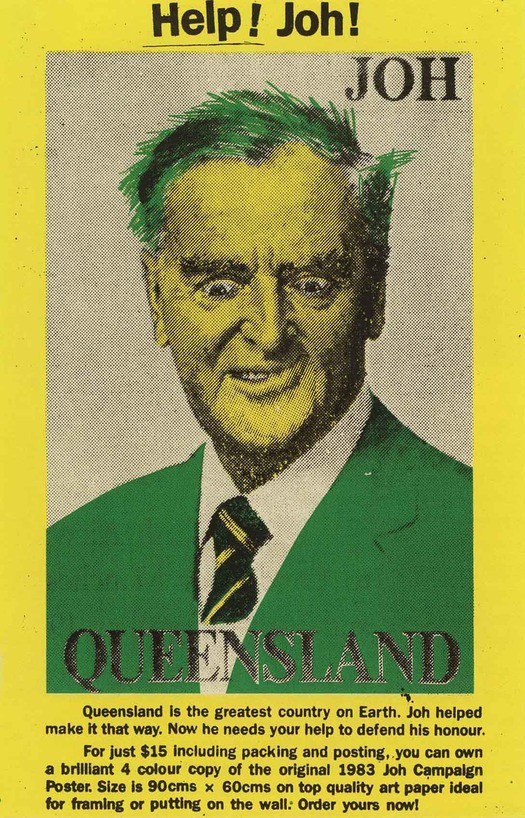
The screen-printed poster phase of the 90s in Northern Australia was not entirely a developed aesthetic movement, rather a political movement. Poynor (2013) describes in his piece, these posters were “street first” (Poynor, 2013, p.8). and not interested in economic success but instead political progress. In one of Stannard’s most famous posters, “Help Joh” (Stannard, 2013), this is clearly evident. Every single facet of the poster, in some way or form, revolve back around to Stannard’s determination of political critique. The piece is a satirical take on the typical politician campaign advertisement. It was Stannard’s method of essentially making a total public mockery of the then widely criticized Queensland Premier Joh Bjelke-Petersen. The posters features a portrait of Bjelke-Petersen defaced with a stupendous expression, overhead in the border of the poster the title reads: “Help! Joh!” (Stannard, 2013) The sub-text below reads “Queensland is the greatest country on earth. Joh helped make it that way. Now he needs your help to defend his honour.” (Stannard, 2013) It is a humorous and ironic statement when you take into account the context of the time and place of Queensland in the 1990s. As previously mentioned, the authoritarian Bjelke-Petersen had an overtly strict rule over Queensland, so much so, that Poynor (2013) describes Queensland as “as many as 25 years behind the rest of Australia” (Poynor, 2013, p. 7). So By calling Queensland the greatest country on earth is not only to make a mockery of the intelligence of Bjelke-Petersen and his followers, but furthermore to highlight the complete isolation that Queensland, both in societal and political matters, had in comparison to the rest of Australia. Stannard really emphasizes his sole blame on Bjelke-Petersen in the sharp statement “Joh made it that way” (Stannard, 2013). And by Stannard calling Bjelke-Petersen’s misplaced legacy as an “honour” (Stannard, 2013) he titles the political and societal decimation that the premier had on the state. The text below ironically calling the print a “campaign poster” (Stannard, 2013) and the advertising of buying your own copies is another satirical take on the misplaced over-patriotism. The aesthetic of the poster is at least on the surface unassuming and simple, yet with further inspection it is clear that it is, like the rest of the print, fiercely politically motivated. This satirical over-patriotic tone is also seen in the posters in the iconic Australian green and gold colour. The colours are bright and pop-style like so many other Inkahoots posters. This bright pop-style colour is easier to understand when you place it in context of this “urban gallery” (Poynor, 2013, p. 8) of Brisbane that as Stannard recounted. Stannard understands this “street first” (Poynor, 2013, p. 8) motif behind these posters. This poster would have to fiercely stand out from the rest of the identically bright and colourful posters that would surround it. Yes, this poster is a work of art by Stannard but most importantly it is a scream for political change in Queensland. The bright colours are not to draw the eyes of the Brisbane streets into marveling over an aesthetic spectacle but instead to let Stannard’s political and societal concerns be known.
Unlike the rest of the prospering Australia, Queensland was recovering from an authoritarian era of then premier Bjelke-Petersen which stunted Queensland’s political movement and furthermore societal identity. This poster, like all produced by Stannard, weren’t pretty pieces of artworks to be sold, they were instigators and catalysts. The posters weren’t in exhibitions, they were created to be displayed to the people of Brisbane in the streets. Stannard’s posters were a display of passion, created to shake Queensland from being dormant in societal, artistic and political growth. And although Stannard is a forgotten hero and will not go down in the history books as one of the most skillful artist of Australia, his impact on the political landscape of Queensland will linger forever.
References
Chris Stannard, 1991, Help! Joh! by Inkahoots, screen-print, https://designobserver.com/media/images/Inkahoots1_525.jpg
Rick Poynor, 6.26.2013, Inkahoots and Socially Concerned Design: Part 1, Essays Design Observer, 1,
5-8
 Design Ideas