The Bauhaus School was created with the idea of combining arts and craft, design and architecture into an eventual single field and is often credited with having a huge impact on modernism across many disciplines.
But among those studying and teaching at the Bauhaus, certain people are more commonly accredited than others, despite the certain works and their impacts on the standards of commonly practised design, the female creators of such works have often been overshadowed by the works created by the equally talented, yet male, designers at Bauhaus.
Anni Albers joined Bauhaus in 1922 along with future husband Josef Albers. Anni, who had previously trained as a painter under Martin Brandenburg, has said that she began doubting her skills when male artist Oskar Kokoschka bluntly asked her “Why do you paint?”.
Anni sought to learn glasswork and painting at the Bauhaus, but was declined, as Bauhaus prohibited women from attending most of their workshops at the time. Josef Albers however, quickly became recognised as a master within his own practice.[1] Anni was instead forced to enter the Weaving workshop, which was viewed as a feminine skill. But Anni embraced her position as a weaver and began creating works that impressed many at the Bauhaus, eventually earning her the position of head of the weaving studio in 1931, making her one of the first female designers to hold a position of power at the school.
Anni’s work whilst at the Bauhaus was not only challenging to the Bauhaus status quo, but it challenged many ideas that connected weaving to a craft rather than art or design.
Anni is quoted as saying “to let threads…find a form themselves to no other end than their own orchestration, not to be sat on, walked on, only to be looked at.”[2]
She was implying that just because weaving was traditionally used as a means to create practical or decorative household ephemera, the combination of threads could ascend into something more.
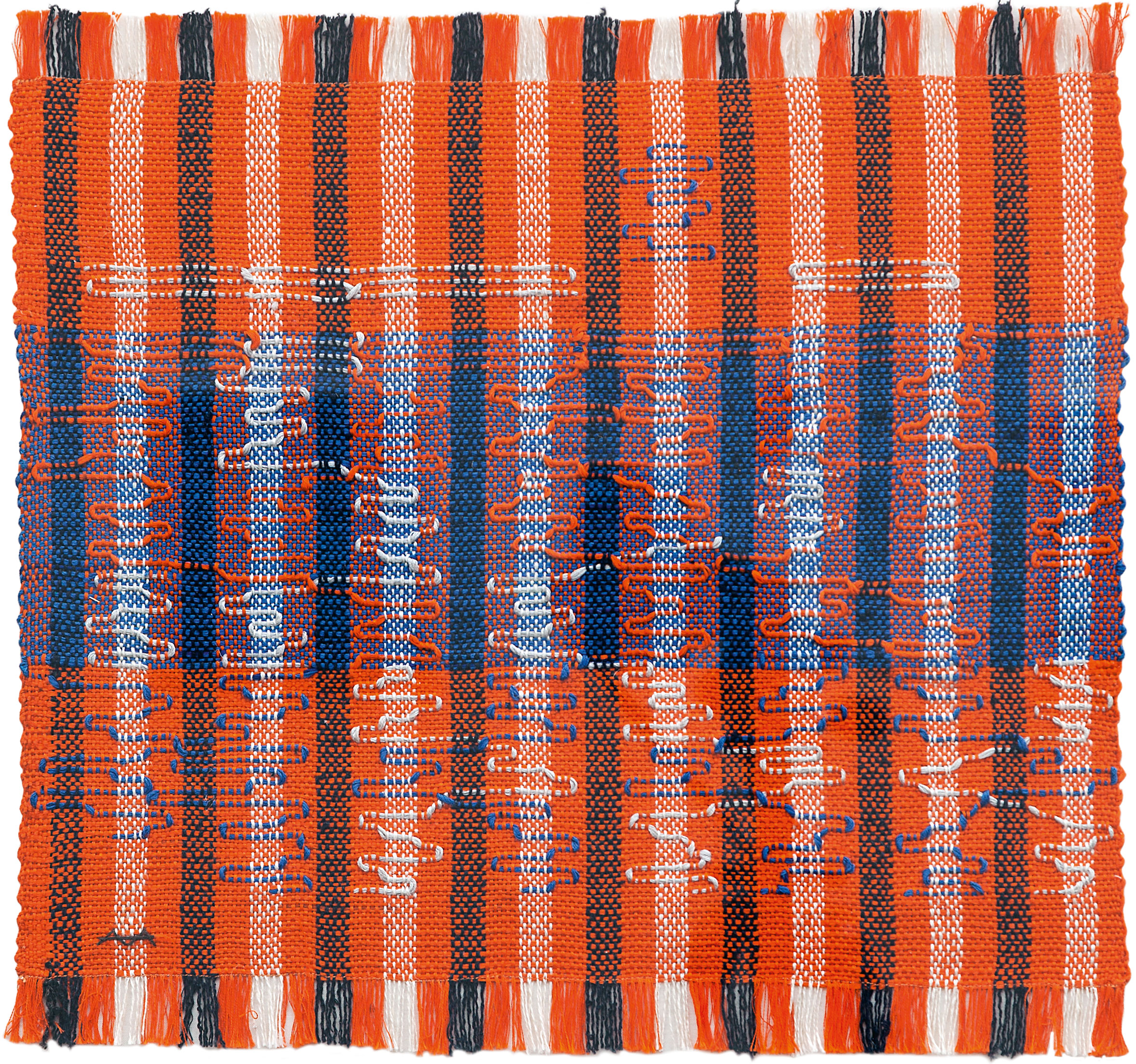
This idea can be seen perhaps most strongly in her work ‘Intersecting’ from 1962, long after the Bauhaus was forced to close by the Nazi Regime. The work’s impact is in its use of colour, form, texture and movement. It is also jarring to see a work of weaving that was produced not with the idea of symmetry in mind, but rather, breaking that tradition form with a flowing sinuous line that is leading the eye all over the piece. It is also interesting to note the use of weaving own medium to break itself, rather than introducing a new element, Albers has used thread as the method by which to break the understanding of what a woven textile should be, or appear to be.
And yet this piece retains its usability. It would fit into many modern homes as a rug or wall hanging, but also as a respectable piece of art that questions itself.
It is interesting to think that Albers was barred from pursuing a male oriented design workshop due to the rules of the establishment, and yet she has created work that weaves lines between many areas of design using this weaving workshop as her foundation. This is perhaps one of the most successful examples of Bauhaus’s original raison d’etre, adding painterly qualities into textiles and giving them a new realm to exist within. Albers has been quoted as saying that originally she thought weaving was ‘Sissy’. Perhaps the ideas of the time in regard to gender roles were so ingrained that even the women of Bauhaus shied away from things traditionally seen as women’s work because of the power and importance associated with male dominated fields like architecture. But Albers has proven that power can be associated to any field, and any field can be changed and manipulated regardless of gender association.
While Bauhaus began as a ‘boys club’, it eventually was beginning to recognise its own female talent, unfortunately this was cut short by the Nazi Regime in 1933, and the strides that female artists within the Bauhaus hierarchy were making were cut short. Perhaps if the Bauhaus had remained open, it may have been able to develop into an establishment that could have lead the way for similar institutions of the time in establishing a female presence in the design world of modernism. The skills of many female artists within Bauhaus has forced the male staff to take notice.
For instance Marianne Brandt, in recognition of her talent, was given a space in the metalwork workshop, which was a workshop strictly reserved for men, and in 1928 she even rose to become the head of the department.[4]
Unfortunately the design field has been strewn with similar incidents of gender identity impacting the distribution of work and while no longer forbidden, there is still a skewed instance of female students studying traditionally male design area.

The article ‘Women Designers Is There A Gender Trap?’ by Margaret Bruce and Jenny Lewis aims to understand this trend, even 50 years after the closing of the Bauhaus. It can be seen from the above graph from this article that female students are not studying areas like Industrial design, whereas areas like graphic design have a fairly even distribution.[5]
Bruce explains that perhaps this can be boiled down to female students being faced with the idea that women should not be doing certain things. Not just from men but also women who have grown up believing certain ideas about gender, the pressure of fighting against those forces from every angle is just too great and it is easier to shy away from something that people will actively try to dissuade you from pursuing.
It is noted also in the article that the design fields seen as traditionally female disciplines should not be disparaged or seen as less important, but re-evaluated. This ties in perfectly with the way Anni Albers tackled the art of Weaving, not just as an area of work designated for women, but as a way to break boundaries and elevate the benign.
[1] accessed on 05/04/2019, https://albersfoundation.org/artists/biographies/
[2] Dominic Lutyens, ‘Anni Albers And The Forgotten Women Of The Bauhaus’, 2018, accessed on 05/04/2019, http://www.bbc.com/culture/story/20180919-anni-albers-and-the-forgotten-women-of-the-bauhaus
[3] Image accessed on 05/04, https://www.tabletmag.com/wp-content/uploads/2018/12/Anni-Albers-Intersecting-1962.-X64702.jpg
[4] Lou Stoppard, ‘Why the fearless women of the Bauhaus are the forgotten trailblazers of art history’, Jan 2019, https://www.sleek-mag.com/article/bauhaus-women/
[5] Margaret Bruce, Jenny Lewis, ‘Women designers is there a gender trap?’, April 1990
fig.1, Screenshot from ‘Women designers is there a gender trap?’
Callum Douglas – 28830644 – topic 3: forgotten superheroes of design

 Design Ideas
